Nine podcasting and audio tips for journalists
Podcasting advice from Wired.co.uk, the Economist, The Times and SoundCloud
– 4 min read


Podcasting advice from Wired.co.uk, the Economist, The Times and SoundCloud

This article was migrated from an old version of our website in 2025. As a result, it might have some low-quality images or non-functioning links - if there's any issues you'd like to see fixed, get in touch with us at info@journalism.co.uk.
There are many different styles of podcast; Wired.co.uk and the Guardian offer a round-table discussion between journalists, the Economist produces word-for-word audio editions of the print and digital edition and BBC-style interviews between journalists and contributors, during the Olympics The Times offered a packaged podcast including interviews with correspondents, and other news outlets create round-up reads of news from that day or week, such as The Next Web's Daily Dose .
There are lots of innovative uses of audio by news outlets. For example, when covering the story of the Colorado shootings earlier this year, the Denver Post used SoundCloud to share audio, including police dispatch calls ; France 24 cuts snippets of interviews and embeds them within some stories , and BBC World Have Your Say segments parts of the radio show into easily digestible sections.
This feature compiles a list of audio and podcasting tips from
, editor of
;
, digital editor,
;
, freelance podcast and radio producer who produced The Game podcast for
; and
, audio content manager,
.
Chris Skinner, who produced The Game podcast for The Times, encourages all large news outlets with a print legacy to showcase journalists' expertise.
"All national newspapers have such a wealth of talent at their disposal. You are really missing a trick if you do not get those voices out there."
During the Olympics, Skinner produced a daily podcast for The Times by interviewing correspondents and columnists and packaging them into 15-minute round-ups, which were offered on a variety of platforms including via The Times iPad app.
"Voices can promote your newspaper,' Skinner said.
Many news outlets, particularly TV and radio broadcasters with a wealth of audio available, are finding creative ways to re-purpose that content.
For example, France 24 takes short snippets from interviewees to embed into online news stories , the English-language of Deutsche Welle includes audio as part of some stories , and BBC World Have Your Say cuts its radio show into segments.
The above outlets use SoundCloud to host the audio, which can be embedded into news stories.
Consider "segmenting and 'chapterising' your content into more digestible sections", Ben Fawkes from SoundCloud suggested. That helps "people's attention spans" and offers audiences a way of getting selective audio on demand.
Wired.co.uk spent £350 on equipment to create the outlet's podcasts, which get 20,000 to 30,000 weekly downloads .
"I've been in podcast studios that cost $1 million," Nate Lanxon, who produces and presents Wired.co.uk's weekly round-table discussion podcast, said.
"Although it's easy to make a podcast, it's not that easy to make a good one, but money doesn't necessarily be the deciding factor."
Another piece of advice from Lanxon is be thick-skinned when it comes to feedback.
"When people start listening to you instead of just reading you it becomes a lot more personal when they are critical because they are really criticising you and your voice rather than just whatever you've written. People should be prepared for that and learn to deal with it."
Skinner likes to make podcasts "to the same standard as if it was being broadcast on FM radio".
He feels that 75 per cent of interviews are "waffle" and advises taking time to "trim out the excess stuff".
"I want every single little piece that I have to really zing," he said.
Skinner urges those with a print background to be clear and concise when taking part in a podcast.
"A print journalist can edit once its on a screen in front of them but they must learn to do that while they speak."
Skinner, who presents the links between the interviews, does not encourage producing a packaged podcast in one take. "I will quite happily pick up and pick up if I think we can get better material," he said.
Skinner also recommends being ambitious when requesting interviews.
"I would also suggest that people do not limit their ambition with who they aim to talk to. It's amazing just how important, famous, and seemingly hard to reach people will offer a bit of time for a short chat with a well planned approach."
Make your podcast easy to access by pushing it to as many platforms as possible. The Economist offers it podcasts via iTunes, SoundCloud
, 'Economist radio' on Facebook , a Chrome browser extension and the player on its own website , for example.
Skinner used "a GCSE business studies-type comparison", saying, "there's no point in opening a shop stocked with the best goods if no one knows where it is or when it's open".
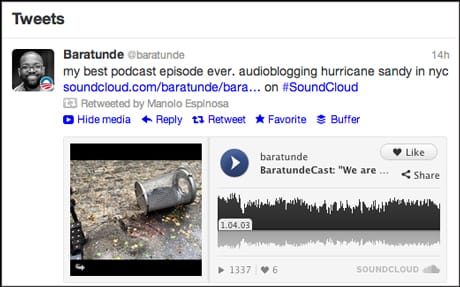
Using SoundCloud as one of the distribution platforms means your podcast will be playable in Twitter within a tweet that is no longer limited to 140 characters. The integration means there is a play button in tweets containing audio.
"It's the next level of real-time audio creation," Fawkes said.
Lanxon from Wired.co.uk advises experimenting. "Don't necessarily think that your first idea for a podcast is going to be the best idea," he suggested. He binned the first ever episode as he decided it was not good enough.
"Failure should be seen as a very positive thing, because not everyone is necessarily going to respond well to your first experiments and so taking that feedback on board and listening to criticism is incredibly important."
Tom Standage, digital editor of the Economist also urges experimentation.
There are lots of different styles of podcast and "there isn't a right answer," he said. "We are all making it up as we go along and I think the crucial thing to do is experiment as much as possible both with the formats and with the technology."