


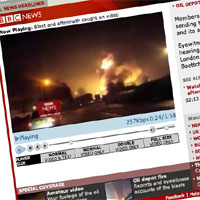
 The reaction to the massive fires at the Buncefield oil depot yesterday demonstrated how citizen reporting is becoming an instinctive public response to major news events.
The BBC received 6,500 emails containing mobile phone photos and video clips - 5,500 more than the number received after the terrorist bombings in London on 7 July 2005.
The site's video News Player recorded 525,000 requests in just one day, and readers' content generated 250,000 requests.
One piece of footage broadcast on Sunday's 10 O'Clock News was shot by two amateur documentary makers who filmed the 200 foot-high flames from a field close by. Andy Dicker and Andy Ash ran away from the fire when they noticed an unexploded tank next to the blaze.
When reporter Duncan Kennedy asked them why they had taken such a risk to get the footage, they said they knew it was dangerous but their filming instincts took over.
Paid incentive?
The freelance community, particularly photographers, are increasingly concerned that news organisations will exploit the availability of free, user-generated content and use less material from professionals.
Some freelancers within the National Union of Journalists (NUJ) have suggested that news organisations should pay the public for the content they submit.
But Paul Brannan, deputy editor of BBC News interactive, said this is not a practical solution.
"By and large we don't pay for material. I'm not sure that would be a good use of licence fee payers' money," he told journalism.co.uk.
He compared eyewitness accounts with vox-pops on TV reports or listeners' comments on radio which are not paid for.
"Introducing money would change the equation. Someone would be prepared to take bigger risks if they thought they could get a couple of thousand pounds for some footage."
Professionals are bound by a code of practice and can be held to account, he said.
"We don't want people to put themselves in danger to get footage.
"What we're talking about is people that have witnessed a bit of history and want to share it."
The BBC's terms and conditions for reader contributions include the requirement that material does not infringe any law, but do not specifically ask users to behave ethically or in consideration of their own safety when filming or photographing.
Guidance for citizen journalists
Freelance journalist Adam Christie has been working on the union's new code of practice for citizen journalists which will be promoted to news organisations in the new year.
He said that whether payment is involved or not, it is unethical for news organisations to encourage submissions from the public without properly explaining the risks involved.
Professionals have the training and experience to help them assess how much physical risk they should take to get a story, and are usually covered for legal liability.
"Soliciting material from witness contributors implicitly encourages the naïve to take risks either in the hope of glory or remuneration," he said.
"Any news organisation taking material should make the safety and liability risks very clear to its users.
"Broadcasters and publishers who solicit amateur material should be aware that they could be encouraging such individuals to risk their lives and limbs, homes and livelihoods."
More news from journalism.co.uk:
Telegraph's 'Snap and send' launch sparks rights grab row
Setting the record straight on citizen journalism
Citizen journalism goes pro
Free daily newsletter
If you like our news and feature articles, you can sign up to receive our free daily (Mon-Fri) email newsletter (mobile friendly).