Aesthetic journalism: Overcoming censorship and documenting Syrian conflict with a sketchbook
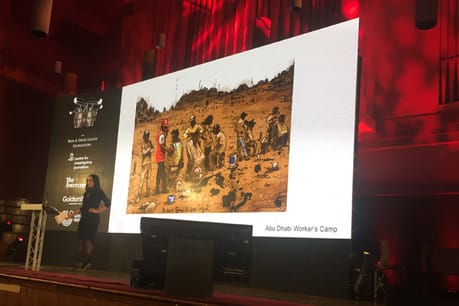
Award-winning artist and writer Molly Crabapple explains how investigative journalism and visual art complement one another at the Conspiracy Logan Symposium
This article was migrated from an old version of our website in 2025. As a result, it might have some low-quality images or non-functioning links - if there's any issues you'd like to see fixed, get in touch with us at info@journalism.co.uk.
Speaking at the symposium, she talks about how 'aesthetic journalism' has its advantages when up against adverse reporting conditions, most notably censorship.
While reporting on Syria, Crabapple was able to gain an insight into Raqqa when Hisham sent over pictures of daily scenes under ISIS control that he had 'risked death' to take in secret so she had material to base her illustrations on.
“Besides getting around censorship, art has another power which keeps people safe and keeps people anonymous," she explained.
"The other motivation to drawing as opposed to photography, is that we live in a time when we are so flooded by images. Every single time a policeman knocks protester over the head, a thousand iPhones are raised.
“However this amount of images creates numbness amongst viewers, it creates a jadedness, you see so much blood and death especially on social media and it makes viewers eventually not care.
“What I try and do with my artwork is to force my way past that jadedness. When you draw it is obviously, defiantly subjective. It is obviously filtered through another person, it has obviously gone through someone's eyes and hands. It is saying ‘I put care into this and you should care as well’.
However, in the absence of photos to work from, Crabapple had to draw from Hisham’s recollections when Hisham’s uncle’s internet café, where he worked, was taken over by ISIS. It soon became a location for ISIS soldiers with gory injuries and this was a scene that Crabapple wanted to capture, but had no physical subject matter to start from.
“My job as an artist who was trying to work journalistically, how I can use my pen to excavate Marwan’s memories and this also is one of the most powerful functions of visual art,” she said.
She explained that to capture the image accurately, she would start with the setting ‘in happier times’ then began to add a cast of characters, fleshing them out by their injuries and features.
Then Hisham would help position the characters, even acting out their body language. It was a trial and error process until every inch of the story was correct.
“There are all these events that would otherwise be lost to the memory, because these events happened when no-one had a camera and yet as an artist you can reach back into the past and create a visual representation of them.”
Crabapple also wanted to capture moments that have been recorded — albeit poorly — on smartphones caught in the conflict.
“The Syrian war was perhaps the most photo-documented war in human history,” she said. “But the pictures were taken in the worst possible conditions.”
Wanting to create work that was iconic and was based on real events, such as the Ali Al-Babinsi protest, Crabapple would watch every single blurry video taken from different angles, and print every freeze-frame second. If a video was too blurry, she would re-pose models to make sure the anatomy was correct.
“They didn’t look like much, like blurry smears with tear gas behind them. But once I looked at the totality of them I could figure, 'over here is where they are burning tyres’, ‘over here are the two people fleeing backwards’, and you look at the motions of the crowd and get this panorama.
“I would take all this montage art and screenshots, all of these imposed things and put them all together to create a massive sense of what it must have felt like to be there.”
Crabapple concludes that the traditional art form stands the test of time in the hectic digital age.
"This is the ultimate purpose of drawing stuff in this age when a pencil and paper are so archaic. Drawing is slow," she said.
"In a world that creates so much ephemera out of images, drawing can still create the singular."
Get your tickets for our upcomingNewsrewired conferenceon November 7 at Reuters, London, where you will get a deeper dive into the digital journalism industry.