This article is from our community spotlight section, written by and for our journalism community.

We want to hear about your challenges, breakthroughs and experiences. Want to contribute? Get in touch and help shape the discussion around the future of journalism.


Most articles about AI in newsrooms tend to come from the Global North. Case studies from major media outlets in the United States or Europe. They're useful, it's true, but they often miss something crucial. They describe what's possible with abundant resources, large teams, and technical infrastructure that most newsrooms in the world will never have.

This is not that story.

Between 2023 and 2025, I worked with three Argentine newsrooms of different scales on AI adoption processes and delivered training to another twenty Latin American media outlets. All marked by tight budgets, diverse teams, and constant economic uncertainty. Budget constraints functioned as a filter that revealed what really matters.

Three newsrooms, three scales, one common pattern

Todo Jujuy (2023): Automating to free up time and return to local coverage

Todo Jujuy, a regional outlet in Jujuy province, faced a typical dilemma for local media. Its small team spent hours producing service content (weather, traffic, sports results, and national news) while some of the local stories that truly mattered to their community went uncovered.

We defined a clear objective from the start. Automate the repetitive so journalists could focus on what other outlets weren't covering. We moved forward gradually, with human oversight at each stage, and developed clear internal guidelines on when and how to use AI.

Results came quickly. Within a year, Todo Jujuy went from zero AI-assisted articles to more than 500 per month. Page views nearly doubled, from 1.3 million to 2.4 million, while the number of users tripled. But more important than the numbers was the editorial shift. The team reclaimed time to produce higher-value journalistic content. AI worked because it responded to a clear editorial need, not because it was adopted due to hype pressure.

How AI helped a local newsroom in Argentina boost its reach, innovation and sustainability
This is the second in a two-part series. You can read the first article here. It has been six months since I concluded my work with Todo Jujuy, a local media outlet in Argentina, helping integrate artificial intelligence (AI) tools and processes in their newsroom. Informed by time and data, I’ve gained a perspective on the possibilities that AI offers media outlets if they integrate it according to their specific needs and characteristics.

0221 (2024): Two-level work and tools designed by journalists

With 0221, a local digital outlet in La Plata, we approached integration on two parallel levels. At the strategic level, we worked with management and senior editors to define a shared vision, establish priorities, and develop responsible use policies. At the operational level, the focus was on journalists.

The difference lay in the methodology. Instead of delivering generic tools, we facilitated workshops where journalists themselves learned to design effective prompts and create custom models for their specific workflows. They developed tailored assistants for tasks like interpreting official bulletins, analysing police reports, and generating supplementary content drafts.

Workshops with 0221 in 2024

An internal survey revealed that 90 per cent of the team valued the experience positively, citing ease of use and reduction of repetitive tasks. 70 per cent reported that AI improved their creativity or inspired new ideas. Even more revealing was the production data. During the first quarter of 2025, "production stories" (higher-value articles developed in a single day) increased 129 per cent compared to the same period in 2024, while total content volume grew just 2.2 per cent.

The key was that journalists designed their own tools rather than being limited to using predefined solutions.

From Idea to Implementation: Lessons Learned from the First AI Integration Process in a Local Argentine Newsroom | Audiencers
How 0221, a digital media outlet based in La Plata, Argentina, implemented artificial intelligence to streamline news production, boost journalistic creativity, and strengthen audience engagement.

Clarín (2025): An opportunity to rethink formats and audiences

With Clarín, one of Argentina's leading national dailies, the approach was different. We didn't design a complete integration but rather an intensive exploration workshop with more than 50 journalists and editors from different sections.

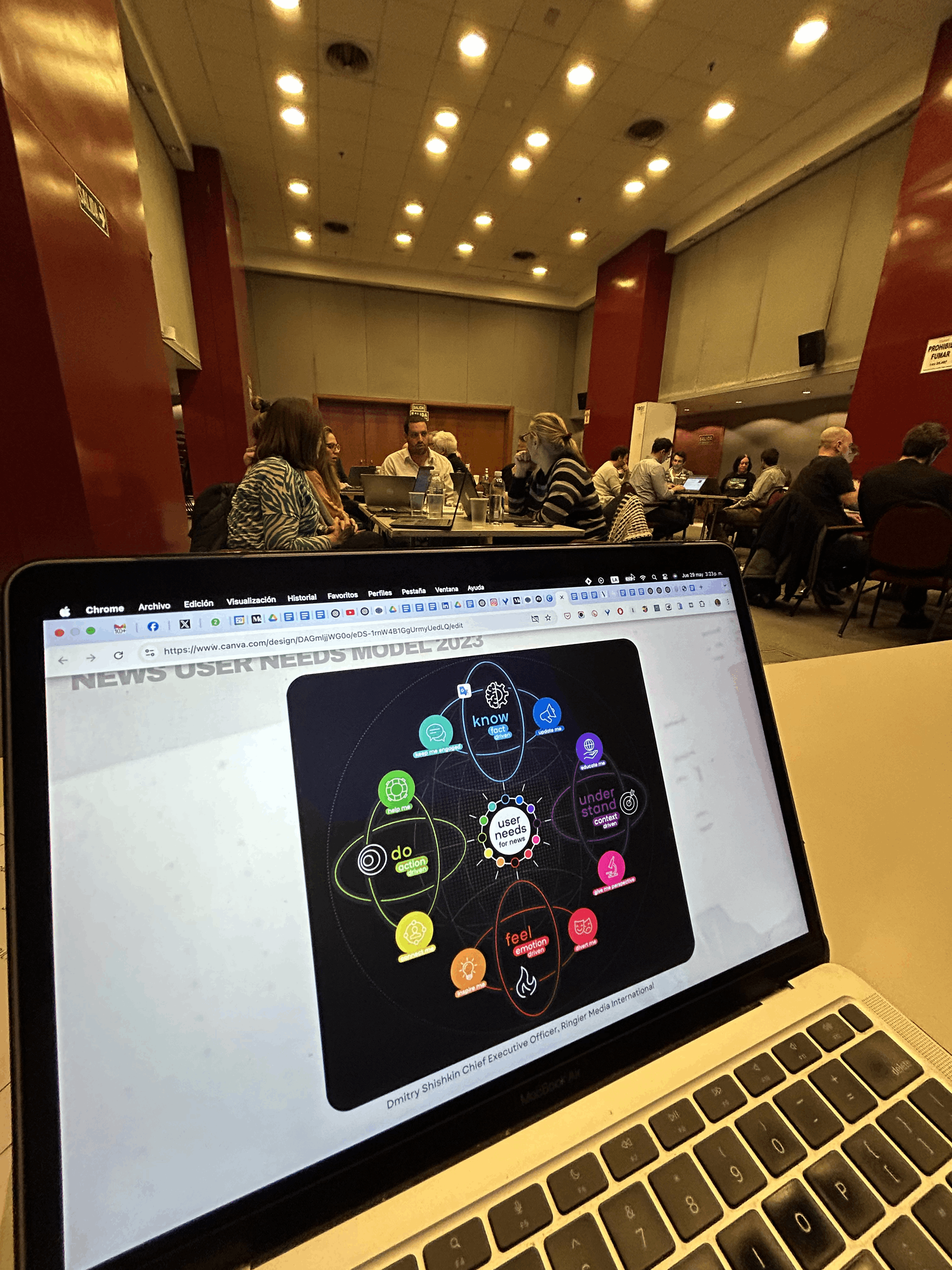
We structured the workshop around three conceptual frameworks. First, Dmitry Shishkin's user needs model, which identifies why people consume news beyond just staying informed. Second, an analysis of changes in consumption habits (fragmented access, limited attention, modular narratives). Third, AI as a cross-cutting technology that can assist multiple stages of the editorial process.

Using the smartocto user needs model in my workshop with Clarín (2025)

Teams worked on concrete prototypes. An automated meeting summariser to improve daily editorial planning. A system for rewriting food articles for key dates. A connector for developing stories with background from the CMS. An automatic reader of technical reports for the Auto section. The value lay in using AI to rethink the journalistic product based on audience needs, not in automating for automation's sake.

Clarín’s newsroom workshop offers lessons in user needs, AI, reader habits
Clarín held a workshop structured around three frameworks — user needs, news habits, and AI strategy — to help the newsroom explore new narrative formats and embed AI into day-to-day editorial practices.

Three cultural traps blocking adoption

Despite differences in scale and resources, three recurring cultural barriers emerged in every newsroom:

  • The generational paradox: Younger journalists often embrace new tools but lack editorial experience, while veterans have deep judgment but may resist or lack support for new technologies. Bridging this gap requires collaboration and mutual respect.
  • Cognitive sedentarism: Relying on off-the-shelf solutions without understanding their workings can lead to rigidity and abandonment when needs change. Teams that experiment and build their own tools adapt more successfully.
  • Survivorship bias: The industry tends to focus on high-profile success stories from well-resourced newsrooms, overlooking failed pilots and the lessons they offer. Real progress comes from addressing local challenges directly and learning from both successes and setbacks.

And five transferable principles for successful AI adoption

Across these cases, several practical principles consistently supported effective AI integration:

  • Training as infrastructure: Ongoing, staged training — rather than one-off workshops — helps teams adapt and lead change.
  • Safe spaces to experiment: Allowing teams to test and fail without fear encourages innovation and helps identify both the potential and limits of AI.
  • Participatory design: When journalists help design their own tools, they use them more consistently and adapt them to real needs.
  • Process before tool: Focusing on the problem to solve, not just the technology to use, ensures AI is integrated with purpose.
  • Metrics and follow-up: Regularly measuring impact and adjusting based on data keeps projects relevant and effective.

These experiences show that successful AI adoption in journalism isn’t about chasing the latest technology or copying big newsrooms, but about focusing on real problems, building skills, and fostering a culture of experimentation and collaboration.

When teams are empowered to design their own solutions, learn from both successes and failures, and keep human judgment at the centre, AI becomes a tool for freeing up time, improving coverage, and strengthening the newsroom’s core mission — even in the most resource-constrained environments.


This article is an edited version of an article published on Alvaro Liuzzi's Medium account, which has been reproduced with the author's permission

Share with a colleague

Written by

Alvaro Liuzzi
Alvaro Liuzzi is a digital media consultant, journalist, and lecturer specialising in media strategy and innovation. He has two decades experience with newsrooms and international organisations on digital products, new narratives and emerging tech.

Comments