Early US user figures suggest little effect from Google/agency publishing deal
Data from Nielsen/NetRatings suggests little change to the amount of users visiting leading US news sites

– 3 min read


Data from Nielsen/NetRatings suggests little change to the amount of users visiting leading US news sites
This article was migrated from an old version of our website in 2025. As a result, it might have some low-quality images or non-functioning links - if there's any issues you'd like to see fixed, get in touch with us at info@journalism.co.uk.
There used to be something here that couldn't be migrated - please contact us at info@journalism.co.uk if you'd like to see this updated! Concerns that Google publishing agency news stories might have an adverse effect on traffic to news publisher's sites may be cooled by early US user data that shows little change to the user levels of leading destinations - and Google News itself.
Early last month, Google struck a deal with several leading news agencies - Press Association and Associated Press included - allowing the aggregator to publish wire service stories.
Despite Google becoming a publisher of sorts, early data from Nielsen/NetRatings on weekly US unique users suggests the number of users looking at news publisher sites and Google News changed little in the three weeks following Google's first publication of wire service stories than from the five weeks prior to it.
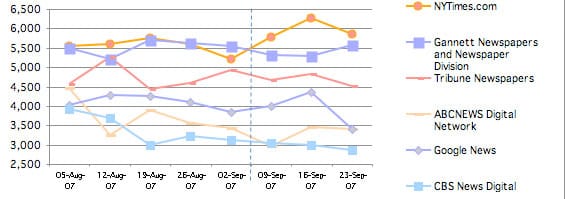
Google News took an upturn in traffic the week following the deal, although not a significant one, before dropping to a level below any recorded in the previous few weeks - all the while recording significantly lower user figures than other major US news sources (see fig. 2).
Three weeks after the deal the New York Times and Gannett Newspapers were recording more users than at the time of its initiation (fig. 2).
The leading US online news source, Yahoo! News, recorded a slight decline in user figures (fig. 1).
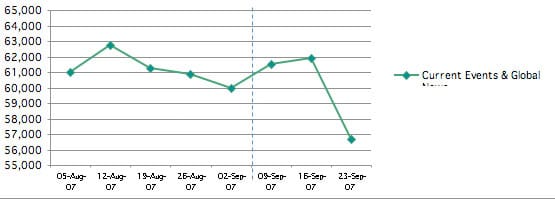
(Figures are in 1000s - eg: in Fig.3, 61,032 equates to 61 million Americans having visited a Current Events & Global News site from home or work in the week of the 5th August)
There used to be something here that couldn't be migrated - please contact us at info@journalism.co.uk if you'd like to see this updated!
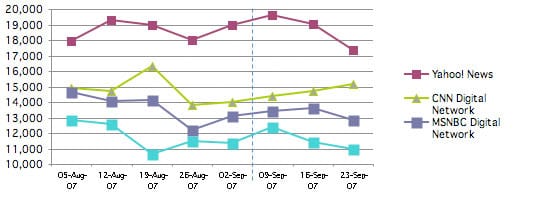
(Blue line denotes date Google started to publish wire stories)
There used to be something here that couldn't be migrated - please contact us at info@journalism.co.uk if you'd like to see this updated!
Despite early signs suggesting little change, the effect in the UK is not yet wholly known as Nielsen only publish user figures monthly for UK news sites - and figures from the ABCE for September are yet to be published - it may also be too soon after the deal to judge effects fully and thoroughly on all news services.
When news of the deal broke, it was welcomed in some quarters of the UK newspaper world. Others also recognised it would remove the clutter of duplicated stories making it easier to get to the original content on which those publications pride themselves .
Concerns still remain for some smaller publishers, however, that they may be crowded out by larger news suppliers if their original stories are covered by agencies, which then come to dominate them in Google News rankings.
Publishers may also suffer in others ways: while weekly or monthly user levels may not fall, the number of page views generated by each user may do so - impacting on advertising revenue - as users seek breaking news elsewhere.
Earlier this week MSN.co.uk's executive producer Peter Bale warned former employers , the Times, along with the Guardian and the Sun that they may experience a 'bump down' in traffic because of Google publishing news stories.
"While the agencies will consider it [the Google/agency deal] as welcome news, publishers should be very aware of what that really means to them," he said at the AOP conference, in London.
"I imagine that publishers such as the Times, the Guardian, the Sun, will start to see quite a bump down in traffic being generated from Google to them from that.”
At the same event Josh Cohen, Google News business product manager, rejected the notion that publishers would suffer from the deal, calling it a 'tremendous opportunity' for online newspapers.
"The issue we had for our users, we often have 50 different stories, half of those could be the exact same article," he told delegates.
"We try to categorise those articles as the same content and reward it by sending users to the originator of that content."
There used to be something here that couldn't be migrated - please contact us at info@journalism.co.uk if you'd like to see this updated!
There used to be something here that couldn't be migrated - please contact us at info@journalism.co.uk if you'd like to see this updated!