Andrew Grill's tips on using AI for writing books, managing talent and mitigating risks
"The main barriers to AI are training, budgets, data quality, and outdated processes. For journalism, it’s about reimagining workflows: use AI as a decision partner to gather news, research, and qualify sources more efficiently"
Gen AI models are making it easier to synthesise information and produce copy. They are also changing reader behaviours. There's no better example of this than Andrew Grill, a former IBM global managing partner, a top keynote speaker and an expert in artificial intelligence, futurism, and digital transformation, with more than 30 years in the technology sector.
Last year, he turned his podcast into a book, Digitally Curious, as a straightforward guide to new technologies for business leaders, with an AI co-pilot for readers to search for the answers they need. AI helped him with the task of turning 60 podcast episodes into a 70,000-word book.
We spoke to him about his AI workflow, shifting reader habits and the tech warnings that newsrooms need to hear right now.
Q: Your book is built from 60 podcast interviews and features an AI-powered co-pilot. How did you approach constructing it, and what do you hope this model unlocks for readers?
Andrew Grill: I came to authorship from a different angle. Most authors become speakers, but I was a speaker who needed to become an author. Writing 60,000–70,000 words from scratch was daunting, so I started a podcast, which over nearly six years produced more than 100 episodes. 60 of those interviews made it into the book. I used Otter, my favourite transcription tool, to transcribe and interrogate the interviews, which gave me about 200,000 words to work with. AI helped me organise and search the material, but the book is very much human-written. I checked every quote and fact myself, with multiple rounds of editing and fact-checking.
The AI-powered co-pilot was born from the idea that a book about technology could quickly become outdated. At the back of the book, there’s a QR code linking to a GPT-based assistant that answers questions and provides updates. This approach lets the book live beyond the printed page, making it a dynamic resource for readers.
Q: Did you have any idea of structure going in, or did AI help with that?
AG: It was never just going to be a book about AI. The first few chapters cover AI in detail, but then I move into topics like web3, cryptocurrency, quantum computing, and self-sovereign identity. The aim was to make technology accessible for everyone, not just technologists. I’ve heard from readers as diverse as a 96-year-old in Brisbane and university students in the UK. The best feedback I’ve received is that it’s "better than expected". Its a back-handed compliment, but it shows the book encourages curiosity and makes complex tech approachable.
Q: What’s your take on how technology is changing reading habits and the role of books?
AG: There’s a real renaissance for printed books because bookshops are busy. But writing about technology means you worry the book will be out of date quickly. I’ve been surprised (and a bit concerned) that what I wrote about AI is still relevant a year later; many people are still on chapter one, unsure how to use these tools.
There’s a lot of hype, but the key is to actually use the technology. Curiosity is essential: try things out, experiment, and you’ll have those "aha" moments that change how you work.
Q: How do you ensure accuracy and integrity when using AI in your work, and what lessons are there for journalists?
AG: AI didn’t write the book, a human did. I was present for all 60 interviews, so I could verify every quote and fact. I always check sources, and I encourage others to do the same. Don’t just trust what AI gives you: click the links, check the outlets, and use critical thinking.
AI can speed up the creative process, but you must stand by your work. If something doesn’t look right, push harder. Ask: "What's your source for this?"
AI will sometimes "hallucinate" or make things up, so always double-check. I read that book nine times, plus I had a human editor as well and we put it through a plagiarism checker at the final stage.
Q: Do you have a favourite insight or story from the book that’s especially relevant for journalists?
For newsrooms, the implications are huge: everything that’s encrypted today—emails, source communications, confidential files—could be decrypted in the future. Foreign states are already recording as much internet traffic as they can, hoping to unlock it when quantum computing advances.
This is a wake-up call for journalists and editors, especially when it comes to source safety and protecting sensitive information. The first step is to talk to your chief security officer or CTO and ask: "Are we aware of quantum-safe encryption, and what are we doing about it?"
While there are ways to mitigate the risk (like adopting quantum-safe encryption), this is a bit like a game of whack-a-mole, because as quantum computers get more powerful, defences must keep up. The key is awareness and proactive discussion: don’t wait until it’s too late to address these vulnerabilities.
Q: What are the most advanced sectors using AI, and what can the news sector learn from them?
AG: Tech and financial services are ahead. They have more resources and are comfortable with experimenting. Across all industries, the main barriers to AI are training, budgets, data quality, and outdated processes. For journalism, it’s about reimagining workflows: use AI as a decision partner to gather news, research, and qualify sources more efficiently. Think of AI as a 24/7 team member - put it on the org chart. But always apply critical thinking and integrity.
Q: What does the rise of AI mean for the next generation of journalism talent?
AG: This is a huge challenge and opportunity. Universities and schools often treat AI as "cheating" so new journalists arrive in newsrooms unprepared to use the very tools they'll need. It’ll be like turning up to your first day not knowing how to use Microsoft Word. We need to prepare people to be work-ready, not just exam-ready. That means teaching critical thinking, digital skills, and how to use AI as a partner.
There’s also a question about how new journalists will get their "10,000 hours of experience to master their craft" if AI can do many entry-level tasks. The most entrepreneurial and ambitious students will make themselves work-ready by being digitally curious and proactive, but the industry as a whole needs to rethink how it develops talent in this new era.
Q: What does "digitally curious" really mean? Give me one tip for journalists or editors they can use today.
AG: When using AI tools, look for options like "deep research" or "deep thinking". Push those buttons and see what happens. The tool will think more deeply, look at more sources, and may even ask follow-up questions. It’s like having 150 PhD students next door. Use all the tools at your disposal, experiment, and never stop being curious about how technology can make you a better journalist
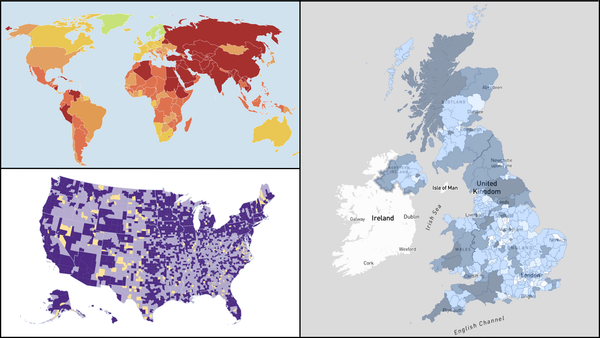
Screenshots of Reporters Without Borders Press Freedom Index (top left), Northwestern Local News Landscape (bottom left) and Public Interest News Foundation Local News Map (right)