When faced with adversity, people usually walk one of two paths.
Some internalise the pain, repeating the cycle for those who come after them. Others, shaped by hardship, make a conscious promise: to ensure no one else has to struggle as they did.
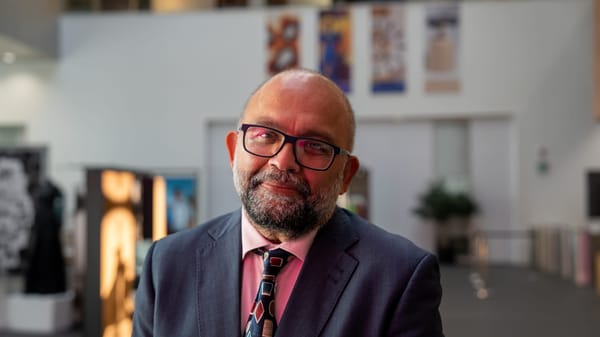
Jaldeep Katwala chose the latter when he agreed to become the new director of the Sir Lenny Henry Centre for Media Diversity at Birmingham City University, an independent body striving to improve representation in UK news media – which, according to the NCTJ, still has much work to do.
Though there are more women than men in the industry, UK journalists are more likely be white, university educated, old (over 50), a British national, non-disabled and to have high-income parents, compared to the national average workforce.
But Katwala is clear-eyed about the limits of statistics: they don't paint the whole picture.
The roots of resilience
His story begins in the 60s, growing up in Bermondsey, south east London, as the Kenya-born son of Gujarati newsagents. Their windows were smashed 17 times in two years, and there were lit rags through the letterbox.
Fast-forward to the anti-migrant sentiment of 2025, where asylum hotels are subject to arson attacks, and he understands what it's like for minority journalists to be plying their trade in today's context.
His parents, determined to give him a better chance, sent him to a private school, which then led to a communications degree at Trent Polytechnic (now Nottingham Trent University), before his first gig at a Gujarati newsweekly.
He then landed a coveted spot on the BBC’s radio training scheme – one of just twelve chosen from five thousand applicants – and his 40-year career has taken him to other UK newsrooms, ranging from Channel 4, to The Bristol Cable, and overseas to The Netherlands, Nigeria, and Papua New Guinea.
Visibility is not the same as progress
He has learned that adversity is a matter of perspective.
"People complain about the trains being late or whatever – but you haven't lived in the country where there are no trains.
"If you want to see poverty, I did a piece in Haiti about people eating clay bricks – adversity is relative."
Take it from someone who has been the only non-white journalist in a Scottish 80s newsroom: none of this is to minimise anyone's experiences.
"It’s really, really difficult to try and be normal in that environment," he admits. "People look at you as if you’re the different one."
Sometimes, his rarity brought a strange kind of fame, including a letter from an expat family in Australia, who missed three things: it's underwear, Scottish football results, and himself.
But visibility, he insists, is not the same as progress. "It gives you a false sense of being. Am I making a tangible difference?"
It's the critical stories he told that helped him to feel at home in the newsroom. He recalls a story of a minority child held over a bridge by his ankles in the 90s in Livingston, Scotland, providing a sense of clarity.
"It's his life that matters, not mine."
Parting wisdom
The value of history is applying a lens from the past to the present day.
So there's a career lesson in Katwala's story for today's journalists who might be the only non-white people in their newsroom: "I’ve always regarded journalism as a public service. Do things of value, not just for your own career. Why do you want to do this? What is your purpose?"
For him, his purpose has never been clearer: "Things can, and do, get better".
More to come from the Sir Lenny Henry Centre for Media Diversity under his directorship in 2026.