'Saddened and frustrated' by ITV regional coverage, says former face of South Midlands
Wesley Smith and Dennis Coath both condemned channel's retreat from local journalism at Coventry University event
– 3 min read


Wesley Smith and Dennis Coath both condemned channel's retreat from local journalism at Coventry University event
This article was migrated from an old version of our website in 2025. As a result, it might have some low-quality images or non-functioning links - if there's any issues you'd like to see fixed, get in touch with us at info@journalism.co.uk.
There used to be something here that couldn't be migrated - please contact us at info@journalism.co.uk if you'd like to see this updated!
Once their faces came into millions of Midlands living rooms each and every night. Now they are out on their ears - victims of the ITV cull of local news programmes and the mass redundancy of its journalists.
For nigh on a quarter of a century, Wesley Smith was the face of ITV in the South Midlands; Dennis Coath was the face of sport for Central in all of the Midlands. They came together this week, not to praise their old employer but to damn them in a event at Coventry University on 'Is ITV losing the local plot?'.
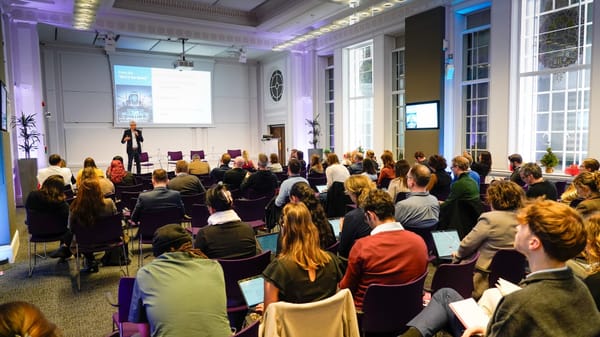
The troubled broadcaster was in for a tough time at the Wednesday lecture, part of the Coventry Conversations series , condemned by its former staff of digging up its local roots and firmly removing itself from the fabric of regional life.
Smith showed his audience a taped reminder of the glory days of the first 50 years of ITV in the Midlands. He was made redundant two months ago after nearly three decades and more in ATV, Central and Meridian.
He had ended up presenting the news for Oxfordshire from an industrial estate outside Southampton. Smith said that the many people shared a great sense of 'regional identity', and that journalists wanted to share that 'sense of belonging' with them courtesy of the news they reported. No more.
Smith's local hero status was confirmed when the Oxford Mail launched a petition to get him back on screen. 2500 signed up. Smith has since presented BBC Radio Oxford programmes and is believed to be in negotiations to front the BBC TV opt out, 'South Today'.
His did not mince his words. "It looks very bleak for ITV," he said, "and after 28 years of work for the channel, it leaves me frustrated and saddened."
Regional broadcasting was the cornerstone of ITV, and its audience built up from the foundation in the mid 1950s. They used it to ruthlessly beat the BBC into the ground often claiming up to 80 per cent of the audience until several gross errors, according to Coath, who worked for ATV/Central for 27 years.
For example, moving the local news to 6pm forced it to compete head on with the BBC News at Six for an audience that was not yet home and settled.
This had been reflected on screen, Coath said. "One of the mantras of ITV is that stories were about people, and not politics. But it has lost its grip on local news as being part of the social fabric of peoples' lives."
The commercial broadcaster had allowed the BBC to steal many of its clothes - relaxed informal news primary amongst them, and also, now, many of its presenters. Both Nick Owen and Suzanne Verdi, who currently front the BBC's 'Midlands Today,' had started on the other side.
The current idea of the BBC playing 'big brother' and offering a home and shared facilities to ITV's local news programmes received short shrift. 'They are the landlord and they will call the tune,' Coath said.
ITV was once in Lord Thomson's famous words, 'a licence to print money.' Today, the money, of course, isn't there. On April 23, ITV announced £2.7 billion losses, leading to another drop in share prices, which at present, hovers around the 40 pence mark. When Michael Grade was named executive chairman in January 2007, the price was 108 pence.
In the last year, ITV has made nearly 500 journalists redundant at local level and 'rationalised' its news operation nationwide. In an ideal world, if allowed by the regulator Ofcom, Grade has made it clear that the commercial broadcaster would like to be out of local news altogether. This view has received a sympathetic hearing at Ofcom, whose CEO Ed Richards said last week said local news was simply 'unsustainable' and needed the BBC to prop it up.
Coath suggested that local news produced by ITV could be saved by allowing for a short, two minute advertising break in the middle of each half-hour bulletin. This, he said, would pay for the programme in its entirety, and free up finances which could be used elsewhere. "It works in the States, and local news is big there," Smith added.
Both 'ITV faces' agreed that a less London focused perspective was needed in programme making. Local ITV franchisees Ulster Television (UTV), and Scottish Television (STV) had continued in their pursuit of the local and are both weathering the media storm much better than their mother station.
At the same media lecture on Wednesday, the former Times and Financial Times media editor, Raymond Snoddy, said that much of ITV's financial woes were compounded by Michael Grade's inability to work with YouTube and Google , because he viewed them as merely 'parasites'. Grade could expect his P45 by the summer, he claimed.