Report: What publishers prioritise in their Facebook strategy
The latest research published from the International News Media Association looks at how the complicated relationship between Facebook and publishers could become a mutually beneficial partnership
This article was migrated from an old version of our website in 2025. As a result, it might have some low-quality images or non-functioning links - if there's any issues you'd like to see fixed, get in touch with us at info@journalism.co.uk.
More opportunities for direct communication with Facebook and response to feedback could help ease some of the concerns publishers have about putting the platform at the core of their digital strategies going forward, according to a report published yesterday by the International News Media Association (INMA).
The findings are based on a survey conducted by Grzegorz Piechota, the paper's author and a research associate at Harvard Business School, with 37 news executives from outlets in Europe and the United States.
Some 83 per cent of the survey's respondents said their publication had a total digital audience of up to 10 million unique visitors, with Facebook generating on average 30 per cent of total visits to their websites.
While the majority agreed the platform has enabled them to reach more people and increase engagement, 68 per cent of publishers said they were dissatisfied with the way Facebook informs them about changes in products and services that have a direct impact on their business.
Furthermore, 65 per cent were unhappy with how their feedback is being taken into account by the company.
Some 41 per cent of those surveyed acknowledged the importance of generating revenue from Facebook advertising, but more than half were not satisfied with the company's current performance in this area.
Publishers also ranked Instant Articles lower in their list of priorities – 46 per cent said they "appreciate the improvements in user experience on mobile [with Instant Articles]", but awarded more importance to traffic referrals, monetisation options and getting information and feedback from the social network.
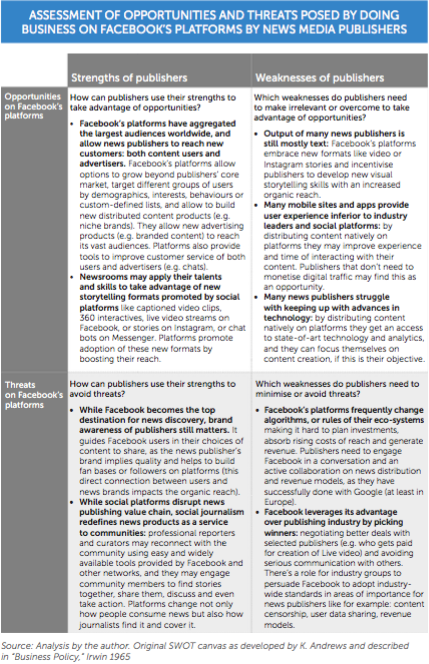
While Facebook has made some efforts to improve communication with the news media online and at industry events, some publishers surveyed by INMA felt the company is "picking winners when signing deals" with specific outlets.
For example, selected media organisations are being paid by Facebook to experiment with its live video feature, but the company has been slow in disclosing how others can qualify for similar partnerships or how the financial benefits are decided.
In the comprehensive INMA report, Piechota also provided an overview of Facebook's News Feed algorithm changes, citing academic research on how people share and interact with content on the platform and whether algorithmic curation leads to 'echo chambers'.
Research from the Reuters Institute for the Study of Journalism published in June found that 44 per cent of people across 26 countries surveyed use Facebook for news and prefer to read stories selected by algorithms, based on their past consumption, rather than articles selected by editors and journalists.
"Within the network, the piece of content has a value only if it is part of somebody’s conversation. Do you want your news content to thrive in social media? Then make it part of people’s conversations," Piechota wrote in the report.
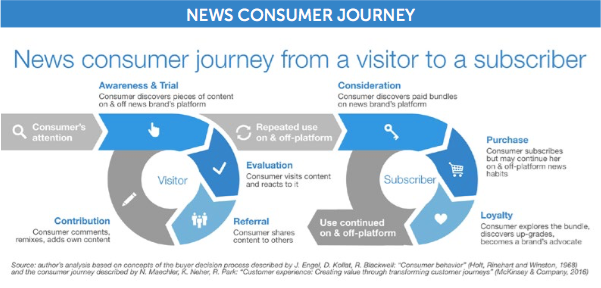
The paper explored further challenges and opportunities for publishers using Facebook, including advertising, news distribution and how the network has changed the game for paywalled outlets, becoming a key way in which both first-time visitors and existing subscribers now discover content.
"Many publishers view doing business with Facebook as a sort of Faustian dilemma.
"They can get rich, but they might lose their souls. Or, to be precise, they can get access to vast audiences and make some money but risk diluting their brand and losing their direct relationship with users.
"We promote the pragmatic approach to Facebook and other platforms. It's part of the everyday business of news.
"It's not marriage. We hope we can be partners," the author stated in the paper.
The [full report](http://www.inma.org/report-detail.cfm?pubid=189) is available for free to INMA members and non-members can purchase it for $695.
Dan McLaughlin (Reach plc, left) and Jacob Granger (JournalismUK, right) in conversation at Newsrewired on 26 November 2025. Credit: Mark Hakansson / Marten Publishing