The Public Method: redefining how to measure journalism's value
A framework used by Dutch public broadcaster NPO considers how to measure the impact of news beyond data

– 6 min read


A framework used by Dutch public broadcaster NPO considers how to measure the impact of news beyond data

This article is from our community spotlight section, written by and for our journalism community.
We want to hear about your challenges, breakthroughs and experiences. Want to contribute? Get in touch and help shape the discussion around the future of journalism.
It can be difficult for editorial teams to demonstrate their value. This applies to journalism in the broad sense, but certainly to public broadcaster journalism. Many editorial teams notice tension between the mission of a particular title and how the title’s success is determined. New ways are being sought to demonstrate the importance and significance of journalism, but it is unclear how to best go about this.
This is largely because many success metrics are based on (individual) audience data: reach, time spent, return, engagement, etc. These say something about how people have consumed the content, but often say little about its relevance to society. For example, has this journalism stimulated a robust social debate? Have unheard voices been given space? Are politicians acting more ethically due to pressure resulting from the critical eye of watching journalists?
In addition, the data we use in journalism is mostly quantitative in nature. We look at numbers and figures, because qualitative data is often much more difficult to measure, assess and communicate. For example, how do you assess a ‘good debate’? When have unheard voices been represented? And to what extent are politicians sufficiently scrutinised? At the same time, qualitative information often contains useful insights on the extent to which the mission of a title has been fulfilled.
An additional complicating factor is that the same yardstick is applied to almost all journalism titles, despite potentially major differences between missions and functions. Financial reporting differs fundamentally from community journalism; a news bulletin is entirely different to investigative journalism. And yet we often assess these on the same category of individual metrics (reach, time spent, loyalty). Aside from the fact that this doesn’t do justice to substantive differences, it unintentionally causes titles to become competitors. This even happens within the portfolio of a public broadcaster like the NPO.
Meanwhile, the public indicates that they are looking for a better balance and more dosage in news consumption. An increasing number of people identify as ‘news avoiders’ (in the Netherlands this figure stands at more than 60% of the adult population) and trust in journalism is under pressure. Increasing polarisation, geopolitical tension and multiple global crises mean that people need journalism that fulfils a variety of functions, that reveals information and calls those in power to account. They need journalism that represents multiple voices in the social debate and offers space for connection and dialogue. These different functions can exist side by side, but each must be assessed on its own merits. And: they are each important.
This discussion prompted Sjoege, together with the NPO, to start the Public Method project. As part of this project, we have developed an integrated method which journalism editors can use to determine their importance to both individual users and society as a whole – and translate it into daily choices, monitor and communicate it. This method can be used to make better and recognisable choices, both by the NPO and by individual broadcasters and editors.
The foundation of the Public Method is the rose model. In this model, the individual needs of the public (shown in the inner ring) are combined with the needs that we as a society have for journalism (the words in the outer ring).
1. Know - People want to keep up, to be able to talk and connect with others. What is important to me; what do I need to know?
2. Understand - People want to understand the context and ‘get’ the news. They want to form their own opinion and be taken seriously. They also want to grow smarter and learn something new.
3. Feel - People want to feel that they are a part of society and feel more connected when they are impacted (whether positively or negatively). The notion of ‘together’ is important.
4. Act - People want to do something with information. What is useful, relevant, what can you do with it? This can be contact with others, something based on personal interests or an event that’s happening in your own life.
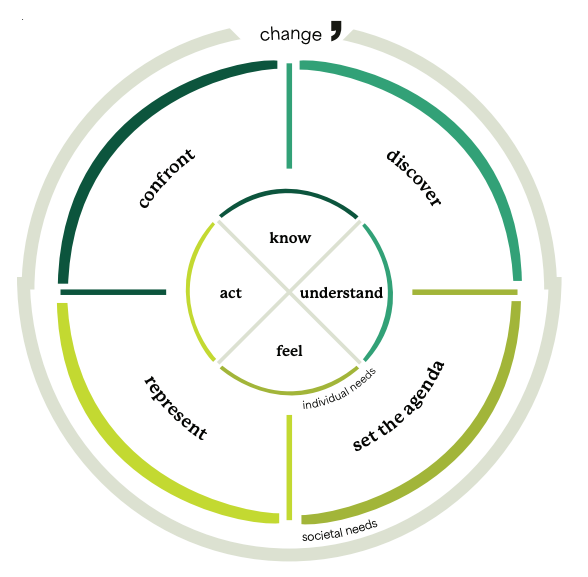
1. Discover - Information must be made accessible to society, both information that is already out there and that which isn’t yet (exposés, doing research).