10 lessons as BBC News hits social media milestones
The recipe for success as @BBCBreaking nears 8m followers
– 4 min read


The recipe for success as @BBCBreaking nears 8m followers
This article was migrated from an old version of our website in 2025. As a result, it might have some low-quality images or non-functioning links - if there's any issues you'd like to see fixed, get in touch with us at info@journalism.co.uk.
BBC News is hitting a series of social media milestones. Earlier today the @BBCWorld Twitter account hit 5 million followers , at the weekend the Google+ celebrated
+1s, Facebook is about to hit the
, and the @BBCBreaking account is about to pass the
milestone.
Mark Frankel, assistant editor of social news at the BBC, explains the key factors that have helped to grow a following of millions.
"There's no great science behind it," Frankel said, but having a dedicated social media team means BBC News can push out regular updates.
"We have a team of six who work day and night and at weekends," Frankel said. There are two night shifts where the social desk is not covered, but it is a near 24/7 operation," he explained.
BBC News pushes out six to eight posts on Facebook a day, three or four on Google+ and, posts 200 to 300 tweets over the course of a week.
Dedicated staffing also means the team is able to highlight "a diet of the BBC's best content", Frankel said. "If you subscribe, you are getting the best of BBC News in one place."
The team work in a joined-up way, posting social media updates linking to a range of output. They are constantly listening to and watching BBC content, enabling them to flag up key pieces, whether a strong interview from Victoria Derbyshire's show on BBC 5 Live or a line from the BBC News channel.
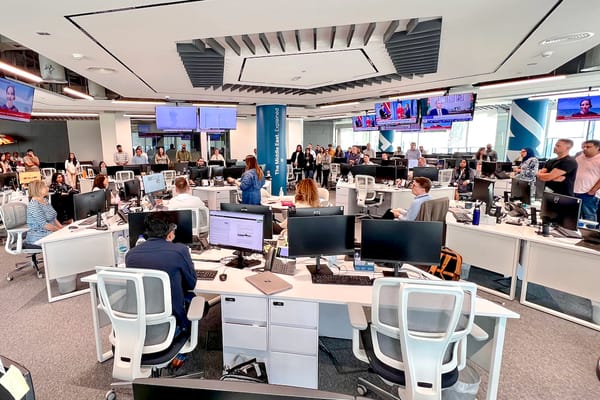
And as they sit next to the web team, there is constant communication.
The social news team moved into the new BBC Broadcasting House, the new newsroom close to Oxford Circus, in the summer of 2012. This has enabled collaboration.
"We now have a UK area of the newsroom and global area and all within 20 yards of each other," Frankel said. "So when a story breaks you are very close to the people working on that story."
Frankel and the team have been keen to join up the dots so individual campaigns or conversations "do not live in a vacuum".
A Twitter Q&A with reporter Tim Willcox in the Philippines following Typhoon Haiyan was "simply an extension of on-air broadcasting", Frankel said.
The social news team aims to "makes sure the content leaps out of the page" on Facebook, Frankel said. They are aware that Facebook users follow multiple sources so the content must shine.
They use a range of techniques, using embedded video, pinning content to the top of the page, and adding image galleries.
"We think about Facebook as a visual product rather than a text service," Frankel said. "We think about every story in terns of its presentation."
The social news team considers the best content for "different regions as they wake up", Frankel explained.
They direct BBC content to people in different areas of the word using Facebook's location feature.
Frankel and his team post stories based on "what is going to travel", he explained. "We specifically look for content that will travel further on Facebook."
Stories that are unlikely to generate much conversation are not shared, and some are avoided as they could result in negative, abusive or even racist comments.
The team is also careful when it comes to posting reports of court cases where comments left by Facebook users could be in contempt of court.
For BBC News, the focus has been flagging up particular types of story on Google +, Frankel explained.
"We've always felt that the page's great strength lies with science and technology stories and those about the environment."
Posts on driver-less cars, global warming, and space have all done well, he explained.
But, perhaps surprisingly, when the team put out a status update to mark the 4 million follower milestone on Monday and asked for feedback, some followers requested more hard news and breaking stories. "So we might decide to mix it up a bit," Frankel said.
The team has also organised Google+ Hangouts. Some Hangouts have taken place with correspondents off the back of the BBC One programme The Editors, for example.
"The feedback is that people like that they can get involved in the content, not just post on stories," Frankel said.
BBC News may have reached a series of milestones but their practices are ever evolving.
"It's a journey we are still on and we are still discovering new ways of engaging with our audience," Frankel said.
This article initially said the BBC News Google page had 4 million followers. It has 3.2 million followers and the milestone it reached was 4 million +1s.