Amanpour: 'authoritarianism is creeping westward where it has no business belonging'
The CNN anchor has spent her career reporting from war zones and interviewing powerful politicians. Now, as the world is seeing a rise of authoritarianism, Amanpour warns journalists against complacency and mistaking neutrality for objectivity
This article was migrated from an old version of our website in 2025. As a result, it might have some low-quality images or non-functioning links - if there's any issues you'd like to see fixed, get in touch with us at info@journalism.co.uk.
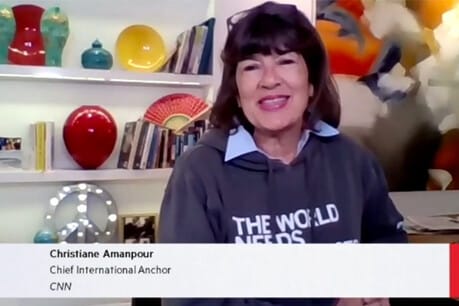
There are few better-recognised journalists in the world than Christiane Amanpour, and few better placed to talk about the changing nature of threats to journalism.
Currently the CNN chief international anchor with her own flagship global affairs programme, Amanpour built her reputation covering the Iran-Iraq War in the '80s and the Bosnian War in the '90s. She described the latter as being "dumped into propaganda".
She has also interviewed some of the best-known authoritarian leaders, including Yasser Arafat, Muammar Gaddafi, Nicolás Maduro and Pervez Musharraf.
Speaking at Financial Times' Future of News event last week, Amanpour discussed what the rise of authoritarianism in the modern age means for media freedoms. The coronavirus pandemic, she said, has also played a big part.
"Authoritarianism - like any of those 'isms' - flourish when populations are under massive stress, when there is an economic crisis, when there is a confusion about where the truth lies and therefore [governments] can exploit that confusion," she explains.
"What worries me is that authoritarianism is creeping westward where it has no business belonging. The sanctity, or rather the integrity, of democracy as practised for several hundred years from the US back east into Europe is really under threat."
The role of social media platforms
Authoritarians are enabled by institutions, Amanpour added, referring to the courts, branches of government, and the media. She identified fragmented media landscapes and polarised social media ecosystems as a core problem, causing division amongst audiences.
Social media platforms, that wanted to champion free speech, have become an avenue of mis- and disinformation from the very top offices. For countries where social media is the predominant source of news, the harm to press freedom is much greater.
"In the last four years in the US we have really seen [social media] reveal itself in all of its massive ugliness. I mean that because what it's done is completely divert people off the road of truth, fact and knowledge. It has polarised, politicised and poisoned even the most basic areas of discussion."
"Most world leaders just don't like journalists, and they don't like journalism unless it's there to flatter them," Amanpour says.
"Even those which belong to democratic nations and know they need to respect the underpinning of the democracy which is a free and independent fair press, nobody really likes it."
Throughout her career, it is Amanpour's pursuit of the truth which has helped her persevere through difficult stories, recalling her coverage of the genocide in the Bosnian war. She quickly learned objectivity and neutrality are not the same and journalists cannot be neutral in the face of injustice.
Speaking about the need for the truth, Amanpour reflected on the accurate representation of the coronavirus science and the facts around climate emergency.
"There was a mistaken idea that fairness and balance were more important than the truth. Journalists and organisations for decades have believed they should equate a minuscule denying group with the overwhelming body of science," she says.
"We need to really get a grip and understand where the truth is and report the truth, and understand that is what [it means to be] objective."
"Sadly, I've been in this position all my career. Whether it's in Iran [in 2009], telling the stories of brave revolutionaries who were not armed revolutionaries but young people who simply wanted reform and a better way of life," she recalls.
"I had to ask them over and over again 'Are you sure that I can publish this? This will be on CNN, it will go around the world, they will see it in Iran. Are you sure?' They were so convinced that they wanted to tell their story that they said yes.
"You have to balance the good of putting that news out against the risk to the people. I've developed for myself a certain code of risk-benefit analysis and it involves having consent."