Trusted news brands matter more in the age of AI, say media executives
In a world of information overwhelm, audiences put premium on human-made content and curation

– 2 min read


In a world of information overwhelm, audiences put premium on human-made content and curation
This article was migrated from an old version of our website in 2025. As a result, it might have some low-quality images or non-functioning links - if there's any issues you'd like to see fixed, get in touch with us at info@journalism.co.uk.
NZME is a digital media company from New Zealand that reaches two million people in a country with a five million population.
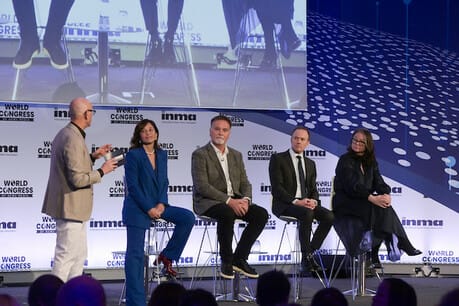
Audio is a big part of its traction, as it has 1.3 million digital radio streamers and 900k podcast listeners. And in the coming few weeks, its listeners will hear synthetic voices on the airwaves, CEO Michael Boggs revealed at INMA’s World Media Congress today (24 April 2024).
Synthetic voices will be trained on multiple human voices and the tech is the proprietary technology of the media company.
Disclaimers will let the listener know that they are hearing a robot, not a human. But Biggs thinks this will drastically improve the speed and scale of their output.
However, Katie Vanneck-Smith, CEO of Hearst UK says that news publishers need to learn from their mistakes in flocking to social media platforms.
"We all got obsessed with scale, not engagement, we thought we could play with platforms and win – and we didn’t," she says.
Hearst is not the magazine print publisher it was in the past; 50 to 60 per cent of revenue comes from digital sources.
Magazines are inherently more "human" products, she says. They were slower to feel digital disruption and they will be slower to adopt generative AI. Hearst will look to AI to play a supporting role in the newsroom but not for content creation.
Vanneck-Smith's hesitance comes from knowing consumers are not yet convinced about the benefits of the technology. According to a YouGov study, only eight per cent of Britons think AI is a force of good.
In a world of overabundant information that cannot always be trusted, she says, humans turn to human-made products. Digital products and services like Spotify show that users favour human playlists over automated ones. Scarcity is a commodity that media companies can leverage.
As such, there will be greater value placed on what the chatbot cannot tell you, says David Rhodes, executive chairman of Sky News Group.
A lot of these tasks require classic journalistic skills: questioning, fact-checking, and editorial judgement. This makes two aspects of the newsroom increasingly valuable: brand and talent.
Rhodes considers star talent a sub-brand of Sky News, which can bring over their own audience segments. As AI-generated content becomes more commonplace, highly recognisable names will be more sought after.
The brand is especially important with specialist media, like Il Sole 24 Ore, an Italian business news publisher, majority owned by Confindustria, the Italian employer’s federation.
"Attention is a currency, the more uncertainty we live in, the more trust will become fundamental," says CEO Mirja Cartia d'Asero.