BBC public survey backs its mission, but questions its effectiveness
The "Our BBC, Our Future" report highlights large gaps between what the public perceives as important and how well the broadcaster delivers on it

– 2 min read


The "Our BBC, Our Future" report highlights large gaps between what the public perceives as important and how well the broadcaster delivers on it
This article was migrated from an old version of our website in 2025. As a result, it might have some low-quality images or non-functioning links - if there's any issues you'd like to see fixed, get in touch with us at info@journalism.co.uk.
A major BBC survey shows strong support for the broadcaster’s core mission, but raises questions about its effectiveness on other key priorities.
The "Our BBC, Our Future" survey drew more than 870,000 responses, and most (83 per cent) respondents backed its core mission to "inform, educate and entertain".
On the other hand, significant gaps emerged between what the public values and how effective they believe the BBC is in delivering on those values. While 91 per cent said independence from government is important, just 43 per cent felt the BBC is currently effective in this area. Similarly, three quarters (76 per cent) said it is important for the BBC to reflect all parts of the UK, but only half (51 per cent) thought it was achieving this.
There were some silver linings for the broadcaster's delivery of news. Two thirds (67 per cent) of people are content with the current level of BBC News output - higher than any other type of programme. Only 15 per cent of respondents wanted more news, while 13 per cent wanted less.
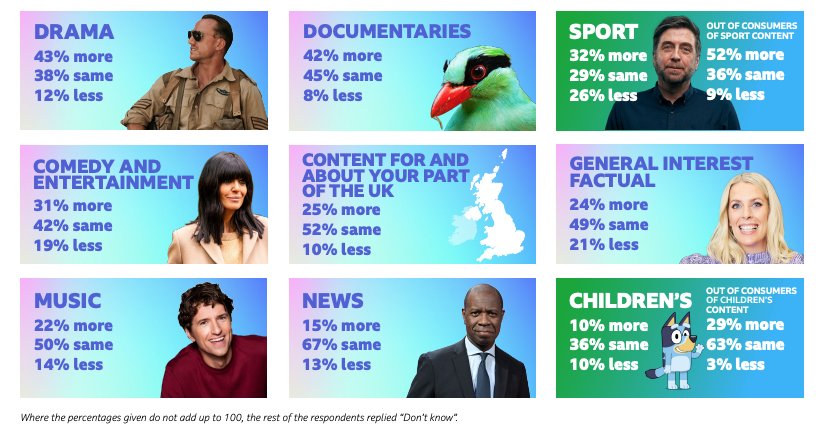
The findings suggest that, despite frequent criticism on social media and in political circles, the BBC retains broad support for its news services among those who took part.
Matt Walsh, head of the School of Journalism, Media and Culture at Cardiff University, defended the public broadcaster recently, describing its ambitions to be universally appealing as a "thankless task". Trying to be 'everything to everyone' risks pleasing no one, as attempts at balance often leave all sides feeling underserved or dissatisfied. The BBC report seems to bear this out, with large gaps between what the public wants and what they feel the BBC delivers.
"It’s easy to get caught up in the social media critiques of the BBC - there are some people with big followings and strong views - but one always has to remember the BBC has enormous reach across the UK population and, as these results show, many people are happy with its services," he told Journalism.co.uk via email.
He emphasised a key caveat in the survey, in that it is self-selecting and may not fully reflect the views of underrepresented groups.
"Other research tells us that the young, people from ethnic minorities, or people from poorer backgrounds want the BBC to be much better at reporting on news that’s important to their communities."
On the question of whether the BBC’s universal mandate is fit for purpose, Walsh is clear: "The BBC’s universal mandate is essential. We are likely to face a period in the near future where high-quality, trusted news, available free at the point of delivery, will only be provided by a very small number of sources. In that landscape, the BBC’s role as a provider of the basic facts and information people need to make informed decisions is essential to British democracy."
He adds that the upcoming charter renewal is a critical moment, urging the BBC and the government to find a solution that helps deliver the best content for the people of the UK.