BBC tests tracking real-time Twitter trends with Zeitgeist tool
Prototype tool is part of corporation's research into users' interests and behaviour on social media

– 1 min read


Prototype tool is part of corporation's research into users' interests and behaviour on social media
This article was migrated from an old version of our website in 2025. As a result, it might have some low-quality images or non-functioning links - if there's any issues you'd like to see fixed, get in touch with us at info@journalism.co.uk.
The BBC is trialling a new tool for tracking how its webpages are shared via Twitter.
The Zeitgeist tool is a prototype developed by the corporation's Research and Development (R&D) team and will be used by the BBC as part of its research into using real-time data.
Users can currently view the most shared webpages of the past 24 hours or from the past seven days. Links are also labelled according to their topic category, such as sport or entertainment, and this information provides an overview of the most shared pages by section across the website.
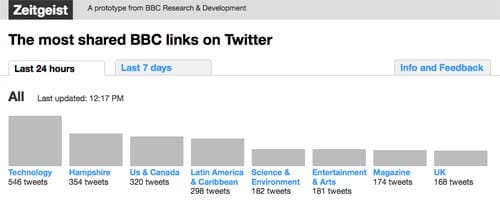
The data is generated using Twitter's API, which Zeitgeist uses to track and aggregate tweets containing BBC links, including shortened URLs.
"The project is part of a larger area of exploration to see how the BBC can use real-time trending data to enrich user experiences (...) We developed Zeitgeist as a simple information source for users and to provide insight into users' interests and behaviours for our production teams," says the BBC R&D's Theo Jones in an introductory blog post .
BBC staff can view more details about the links shared, including a full list of the tweets containing them and associated hashtags. The tool will run for a limited period and is currently processing 300,000 tweets an hour - 500 of which contain links to the BBC, says Jones.
"We think a system like this could feed into BBC Search as a ranking algorithm, as an additional real-time feed for News recommendations, or as a 'news on the move' mobile service. In any case it shows how audiences can help shape and prioritise content," he says.