'Breaking into news' competition aims to address lack of diversity in UK broadcast journalism
2018 winner Hadeel Elshak who saw her piece on the Grenfell tower tragedy air onto ITV News explains the importance of boosting representation of minorities on our TV screens
This article was migrated from an old version of our website in 2025. As a result, it might have some low-quality images or non-functioning links - if there's any issues you'd like to see fixed, get in touch with us at info@journalism.co.uk.
Efforts to raise awareness around newsroom diversity and representation got a lot of press recently.
Looking at latest figures published by Ofcom in September 2018, overall representation of minority ethnic groups in the five major television broadcasters (BBC, Channel 4, Sky, Viacom, ITV News) is at 13 per cent, between April 2017 and March 2018.
It reads as good progress for an industry which sat at 11 per cent in 2016-17, and is now higher than the current level of representation in the UK national workforce at 12 per cent.
That said, one organisation which still seems to have work left to do is ITV News, coming in behind the four other major broadcasters at nine per cent representation.
The competition, while open to applicants of all ages, experience and backgrounds, is also an effort to promote diversity in broadcast journalism, and create pathways into the industry for people that would otherwise find it difficult.
After applicants submit story pitches, ten are selected - each from a different UK region. They then spend time under the mentorship of an ITV journalist to flesh out their story, before the ultimate winners’ piece is picked for airing on ITV News.
Elshak won the competition last year with a piece on the Grenfell Tower tragedy, and spoke of how the competition has spurred her on to go to university, aiming to land a job in journalism after her International Development course.
Because the initiative is a travel-expensed scheme, she said this gives people from different backgrounds an opportunity to produce impactful stories and get their foot on the career ladder. This stands in contrast to the barriers presented by unpaid internships and work experience.
While she said that the issue of under-representation is still felt at home, she stressed that any effort to address this cannot be downplayed or underestimated.
"Just by turning on your TV, you can see how diversity is lacking," she explained. "It tells you that your voice isn’t loud enough to tell a story.
"But when I appeared on TV, I had friends and family saying how inspirational it was to see someone like us being represented. With that sense of familiarity, it motivates other people to think they can do it too. To change that doubt in their head into action.
"I don’t speak for everybody like me, but just to have someone who physically looks like you reminds you that it’s bigger than you, it reassures you that people are included and represented in society."
These words echo back to Elshak’s biggest takeaway from her time under the mentorship of ITV News journalist, Katie Oakes, who used to say ‘remember the story is bigger than you'.
"It comes back to that level of responsibility as well, when I was interviewing and editing, although I had personal connection to this story, this goes beyond me.
"This is for people in the community and the viewers back home. Grenfell wasn’t something which just happened, people are still living with those effects today."
Having kept in close contact with Oakes, Elshak aims to gain more experience with ITV News, following a springboard of opportunities from the competition.
Emerging as winner of the competition, Elshak claimed her winner's prize of £400 which she put towards one of the most essential pieces of tech for any aspiring or active journalist.
"Honestly, my initial application for Media Trust was written on a phone because I didn’t have any other type of equipment," she joked. "I was brainstorming everything on my phone, and afterwards I just thought it wasn’t sustainable, so I bought myself a laptop."
Leading the initiative is ITV News journalist Ria Chatterjee, who encouraged new applicants to learn from Elshak’s example of finding a new angle in an important story.
"A strong pitch will have an overall vision that’s clear and detailed. Candidates should ask themselves a key question: what’s the story? What are you trying to communicate to the viewer? Once you have a clear idea of this you should consider who is best placed to voice the different elements of your piece," Chatterjee said.
"Remember that human, relatable stories are at the heart of news. We want to hear about people’s lived experiences. Think of an interesting ‘treatment’ – television storytelling revolves around strong visuals. So, how are you going to tell your story in pictures? What creative filming techniques might you use to lift your story and make it stand out?"
"As always, it’s about giving a voice to people whose stories go under the radar. Go over your ideas to ensure that your pitch is as thorough as possible. You may not be able to think of everything in one go – that’s okay – broadcast news is a collaborative industry where ideas blossom through team conversation, but do your best to offer as fully formed an idea as possible. This will help your application stand out."
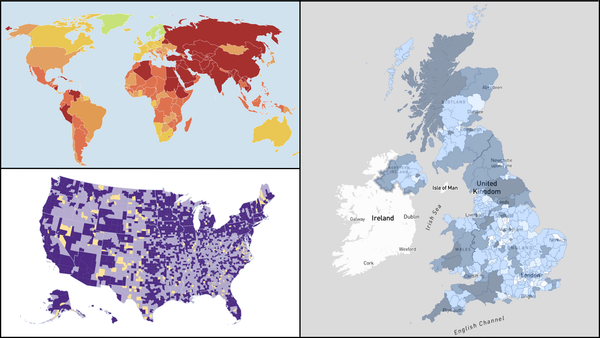
Screenshots of Reporters Without Borders Press Freedom Index (top left), Northwestern Local News Landscape (bottom left) and Public Interest News Foundation Local News Map (right)