Calling all media experts: join a network to help young children have better news diets
The News Literacy Network wants to help the next generation make sense of the news - and it calls for experts in solutions journalism, slow journalism and fact-checking to help out
This article was migrated from an old version of our website in 2025. As a result, it might have some low-quality images or non-functioning links - if there's any issues you'd like to see fixed, get in touch with us at info@journalism.co.uk.
There are plenty of terms and words that we are well-understood within our newsroom walls and by our journalism colleagues. But from the outside looking in, terms like "sponsored content" or the "angle" of a story can leave news audiences scratching their heads.
Even worse, it can leave them not knowing how the story came together, its influence and how well it can be trusted. Perhaps they have heard terms like "mainstream media" so many times the meaning has been lost and they do not know who - or what - to believe.
Jackson aims to help kids from as young as three up to 16 understand how the news impacts them. By better understanding these commonly used news terms - improving their news literacy - they are more able to evaluate the information they encounter every day.
Her research has shone a light on how consumption of negative news is linked to feelings of helplessness, pessimism and ultimately, disengagement. Young children and adults can experience depression, anxiety and sleeplessness through exposure to constant negative news. And she claims that most advice on the subject only suggests limiting exposure to news, rather than giving them the tools to process it for themselves.
"I thought it was mad that these were the accepted side-effects of being informed," she told Journalism.co.uk. "When the product is this potentially harmful, you change the product not the child."
Her solution is for young children to have a better understanding of how the news is produced and presented: being able to spot bias in the news or how to differentiate "opinion pieces" from fact-based articles.
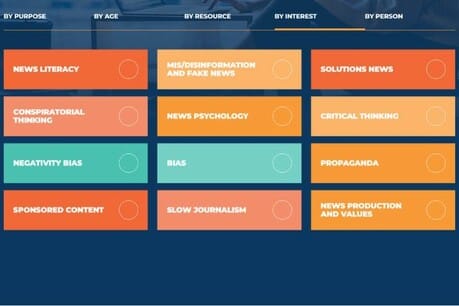
That allows the user - parents or children - to find age-appropriate resources, choosing from podcasts, games, newsletters, fact-checking organisations and articles to name a few. Teachers will also find handy lesson plans. The user can narrow their search by areas of interest as well, such as news psychology, news production values, conspiracy theories and so on.
Jackson has done an initial surface scrape for the website, sourcing more than relevant 100 organisations and 500 resources of which around half have currently been uploaded. It is for now focusing on UK or US-based resources.
Academics, journalists or other media organisations can request to be included on the network if they have professional resources available for sharing. A personal profile section is to come, which will provide direct access to the experts.
Those who join the network might also have the chance to visit UK schools in the future. The NLN is partnering with three schools in Beckenham, Lewisham and Catford next year to bring in a free news literacy curriculum for sixth-form students (aged 16- 17). That work is in collaboration with a curriculum specialist and two researchers, who will also deliver an impact evaluation for this pilot effort.
"Audiences need journalism and journalists need an audience. At the moment, there is something being lost in translation where neither one is really getting good value from the other.
"Hopefully this will strengthen relationships and ultimately strengthen the ability for audiences to use the news as a tool to accurately inform themselves. But there is a lot of work still left to do."