The New Internationalist raises £160k in emergency crowdfunder
The independent magazine turned to its readers to help offset the impact of a pandemic and growing production overheads

– 3 min read


The independent magazine turned to its readers to help offset the impact of a pandemic and growing production overheads
A one-minute read, every weekday. Unsubscribe anytime.
No spam. Unsubscribe anytime.
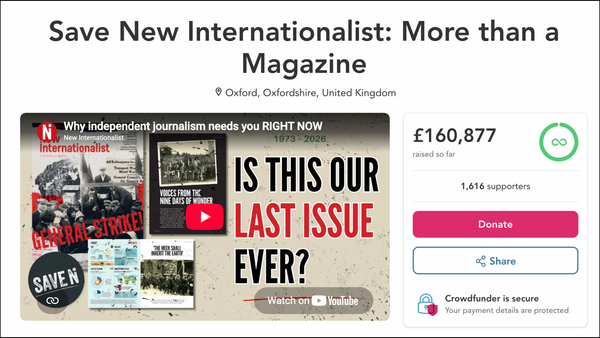
Independent 'global justice' magazine The New Internationalist has successfully raised £160k in an emergency six-week crowdfunder to keep its doors open.
For more than 50 years, the title has aimed to 'tell stories ignored by mainstream media', but has found itself dealing with its own crisis as magazine production costs soar and a cost-of-living crisis squeezes its readers.
The 4,600 reader-owned co-operative launched the ‘Save NI: More than a magazine’ campaign last month, warning that its next issue could be the last if the target is not met. It reached its target on 14 July and can still accept donations.
"We're so grateful to everyone who supported our emergency crowdfunding campaign. Their support has brought New Internationalist back from the brink and shows what can happen when people come together to support independent media," said co-editor Amy Hall in an email, after reaching its target.
"We're proud to be part of a publication with such a long history of social justice and thanks to this support we can now prepare for NI's next chapter."
The situation seems more stark when considering that The New Internationalist was selected as one of the grantees of the Nesta Future News Fund seven years ago — a government-backed innovation scheme born out of the Cairncross Review into the future of journalism.
 Jacob Granger
The fund aimed to help news organisations develop new ways to engage audiences and build sustainable business models. The New Internationalist’s "Bridging The Gap" project, which was focused on making its in-depth reporting more accessible and community-driven, was awarded £30,000.
And it delivered. The objective of the pilot project was a specific edition of the magazine exploring air pollution and climate justice, with some of the stories also appearing online.
The team also tested a community-funded subscription model, which allowed regular readers to sponsor subscriptions for local groups and activists who could not otherwise afford them.
The Future News Pilot Fund was disrupted by a global pandemic shortly after its launch, and although the news publication adapted those projects to lockdown conditions, it was ultimately cut off from its most powerful subscription conversion routes: face-to-face conversations with would-be readers at festivals, conferences and on university campuses. This revenue has since been restored, but has not returned to pre-pandemic levels.
News Club events (monthly meet-ups) and solidarity funds (donations that go towards groups unable to afford subscriptions) came out of the Future News Fund but provide limited revenue.
Inflation and the arrival of generative AI have further disrupted journalism since 2019, and Hall observed that many other Nesta grantees have rebranded, restructured or have gone out of operation entirely.
"One-off grants are not going to be what sustains journalism, although they can help. And for many, they are not going to be a magic bullet to fix the sustainability issue, particularly when it involves additional project work on top of the day-to-day journalism," she explains.
Now that NI has secured £160k from the crowdfunding campaign, the funds will be used to stabilise the organisation and invest in its future:
"Like most media organisations in the 21st century, we are still going to have to turn to our readers for support in future. Being reader-powered protects our independence. What has always seen us through is our readers," says Hall.
"We have 4,600 co-owners who have bought community shares, we have others who donate regularly, as well as thousands of loyal subscribers.
"Since the Nesta project, we have strengthened our democracy, including through work with our Common Council of co-owners who offer critical friendship to NI, but we want to continue to bring our readers and supporters closer to us in the coming years."
This article was updated on 28 July 2026 after The New Internationalist reached its crowdfunding target, with new quotes and information