Highlighting voter indecision: How Reuters is covering the French presidential elections
Andrew Callus, Reuters bureau chief in France, outlines the newswire's approach to covering the French election campaign, and explains how it was shaped by the US election and the Brexit vote
This article was migrated from an old version of our website in 2025. As a result, it might have some low-quality images or non-functioning links - if there's any issues you'd like to see fixed, get in touch with us at info@journalism.co.uk.
Given the hightened international interest in the upcoming French presidential elections, Reuters has taken a new approach to covering the election campaign and the vote, compared to its usual process.
After observing the electoral "shock" generated by the results of the EU referendum in the United Kingdom in June 2016, and the US presidential elections in November 2016, the newswire is being cautious of reporting the results of opinion polls, as well as making focused efforts to identify voting trends early on, Andrew Callus, Reuters bureau chief in France, told Journalism.co.uk.
"In the US presidential election, the media generally was beating itself over the head after Trump was elected, asking why it didn't spot the scale of the trend. I think to some extent it was the same with Brexit. That has had a big impact on the way we report opinion polls and on the pollsters themselves," he said. Stories also include a caveat that opinion polls "can't necessarily be the whole story".
Reuters has been publishing daily reports in different formats about the elections in France since November, when François Fillon won the primary race to become the centre-right candidate. Such frequent and detailed reports about an election campaign are a new approach for Reuters, explained Callus.
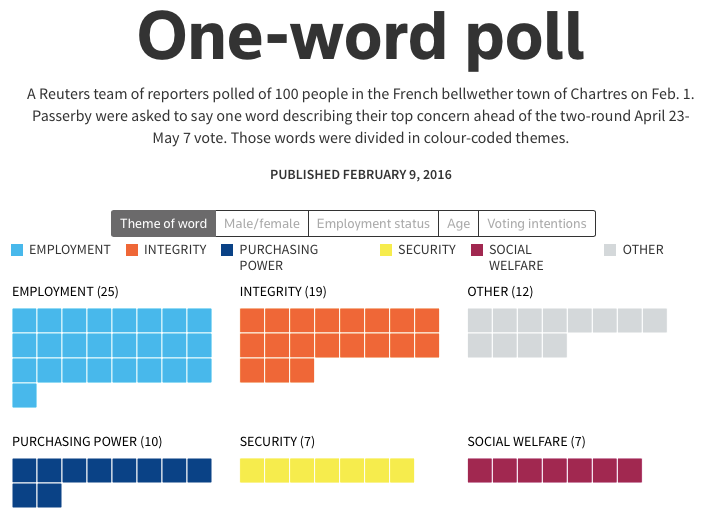
Reuters also works with a team of stringers to cover the campaign outside of Paris, and the newswire has recently covered stories from Chartres, France's "bellwether city" where election results tend to reflect the national results.
The current focus in Reuters' reports about the election, including those from Chartres, is on uncertainty and indecision. "This is something that is becoming a bigger and bigger theme as the election approaches," said Callus.
"What we did was slightly unusual from a newswire point of view. We went there deliberately not looking for a specific angle, but simply to say what is on people's minds for the election. And I think that, to some extent, was against that background of the Trump win and the Brexit vote."
Other media outlets in France have also been looking for clues to where the vote may be headed in the different parts of the country, such as Le Monde with the Françaises, Français project.
Another element reflected in the media coverage of the election campaign in France has been a concern about misinformation spreading on social networks and the emergence of a number of fact-checking initiatives, such as CrossCheck and Facebook's partnerships with media outlets.
At Reuters, the team is cautious in its reporting of fake news. "It's very important for Reuters that we do news, we don't grandstand, we don't make ourselves into the story," said Callus. "The whole controversy of so-called fake news of course is part of the story that we cover and we have been doing that."