This article was migrated from an old version of our website in 2025. As a result, it might have some low-quality images or non-functioning links - if there's any issues you'd like to see fixed, get in touch with us at info@journalism.co.uk.
Former News of the World journalist and whistleblower Sean Hoare named
eight people at the tabloid in connection with hacking, the deputy
editor of the Independent on Sunday said today.
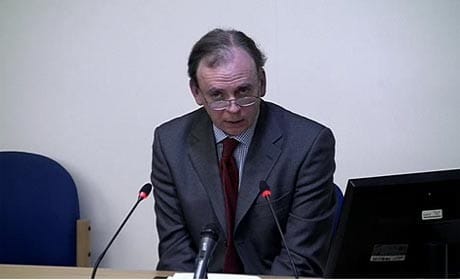
Giving evidence at the Leveson inquiry , James
Hanning said that he had four or five "quite long" meetings with
Hoare following an initial meeting in the Summer of 2010.
Hoare, who
died in July , joined the News of the World in 2001 after stints
on the Sun and the Sunday People. He was fired by then-editor Andy Coulson in 2005 over alleged drink and drug problems.
Hanning said that he built up a trust with Hoare during their
meetings and that the pair "seemed to be on the same
territory".
He said that the former News of the World journalist admitted
hacking "numerous times", and named "a number" of other individuals
at the tabloid who used the illegal technique.
"I remember once, when the police were making progress with a case,
he was speculating as to who might go into the witness box and
testify against people.
"He said: 'X will probably sing in court, and then he named about
eight people."
Hanning was instructed not to reveal any of the names, as this
stage of the inquiry is at pains to avoid prejudicing any future
criminal proceedings.
He went on to say that "all sorts of people" were hacked at the
News of the World and "no one was off limits". He said Hoare had
described an incident in which a female celebrity had given the
mobile number of her PA to a senior executive at the News of the
World, because the newspaper had been trying to contact her, and
the executive instructed another member of staff to hack, or
"screw", the PA's phone.
"The female celebrity handed over the number to a senior executive
who handed it to another and said 'there you go, there is X's
number, tell him to get hacking', or screwing, as the term was.
'That's another phone to screw'."
He also gave the example of a cabinet minister, who he said told
him that a tabloid executive would not authorise the hacking of his
phone, as they were friends.
"And I thought crikey, they still don't get it."
According to Hanning's testimony, Hoare also revealed to him that
the News of the World regularly paid £400 to obtain rival
newslists. He said Hoare would pay £200 in cash to a member of
staff in the rival title, take £100 for himself and give £100 to
another NoW executive.
"I understand there was a certain amount of cash around the office
... Sean said he would pay someone at another newspaper for their
newslist. He would get £400 in cash and a person was paid £200 to
hand over the list and £100 would go to Sean and £100 to this other
executive."
Hanning said he did not hear from Hoare about other cash payments
to third parties, but said it was "long recognised" in the industry
that "police will tip off a friendly journalist" and that, at the
News of the World, "it was assumed cash made things happen".
"They may get a free meal, they may get £50 out of it. Police are
known as the source of stories."
Asked about phone hacking at the Sun, which Hoare's bother Stuart said in his evidence this morning was
"routine" , Hanning said he didn't remember Hoare saying
anything about it specifically, but added:
"If I'm not speculating, he would assume that I would understand
that to have been the case. It seemed to be implicit."
He also said that, while he didn't have any reliable evidence, he
heard rumours about hacking at other newspapers, both tabloid and
broadsheet.
"I've heard it talked about, but it isn't more than hearsay."
"In relation to tabloids or to broadsheets, or both?" the inquiry
counsel asked.
"Both, but I have no concrete knowledge of that."
Hanning was asked about blagging, the practice of obtaining
information through deception, which he said was "widespread",
adding that there had been a "creeping acceptance" of such methods
in the industry.
"In the past they might have been useful for standing up a story,
to prove it was correct. They seemed to work in proving the truth
of a story. But then they came to be used more commonly, more
regularly, and came to be the start of a story with fishing
expeditions."
Despite Hoare having battled with drink and drug problems, Hanning
said that his judgement was not impaired during their meetings. He
also told the inquiry that he did not believe Hoare to be motivated
by grievances with the News of the World, or by money.
"To say his motives were entirely public spirited would be an
exaggeration. But that's not to say he wouldn't have thought very
seriously about why he was doing it," Hanning said.
He also told the court that Hoare was offered £60,000 at one point
to sell his story, but the former News of the World journalist
declined the offer.
They had planned to write a book together about the scandal,
Hanning said, but it "never really got off the ground".