'It's easier to break the rules when you know them' – Q&A with Mitra Kalita
Managing editor for editorial strategy at the LA Times shares her views on skills, career, emoji and how journalists should 'never have a quiet cab ride'
This article was migrated from an old version of our website in 2025. As a result, it might have some low-quality images or non-functioning links - if there's any issues you'd like to see fixed, get in touch with us at info@journalism.co.uk.
I am the Los Angeles Times managing editor for editorial strategy. I like to think of my job as one that continuously asks the question of where is this newsroom going? How will we serve readers today? This minute? Next week? In five years?
One of the appeals of my job is that editor-in-chief Davan Maharaj never tried to separate me as a “digital strategist” in any way. He and I deeply believe in an online-offline connection between the many forms of LA Times journalism.
It depends on what you consider a "start". My first full-time job in journalism was at age 22 as a newswoman for the Associated Press. But we could rewind a few years and ask if it was actually when I was…
18 – and joined the college newspaper, The Daily Targum, at Rutgers University
16 – when I was selected for a “minorities journalism workshop” at then Rider College as part of an effort to diversify newsrooms
12 – I signed up for the Panther Press, the middle-school newspaper, because I had just moved to New Jersey from Puerto Rico and I sat alone at the lunch table and felt I needed to make friends – and quick. My first story was on standardized test scores and I got to interview the principal.
I have a decent BS detector. I respect stories that are complicated but respect a reader’s time and smarts - Mitra Kalita, the Los Angeles Times
I love hearing what’s happened. Years of working overseas or with overseas teams conditioned me to picking up my phone several times a night. I am trying to break the habit but I pay attention to news alerts, email newsletters, Facebook and Twitter feeds, neighbourhood list-servs, text messages with gossip, WhatsApp messages from my friends and cousins in India. I am pretty much a blank slate every morning looking to consume and also at ways “in” to stories.
If Twitter is going crazy over Homer and Marge Simpson breaking up, my mind leaps to what that means for feminism and the American marriage and the state of the Simpsons. I cannot help connecting dots and contextualising as I read news.
But the best part of being in a newsroom, especially like the LA Times, is the chance to riff off each other. I love working with reporters, editors, photographers...
I am going to sound so lame but I never got into emoji. My friend Rebekah Monson runs a site in Miami and just developed a bunch of city-specific emoji. I loved that idea and it dawned on me that perhaps I don’t like emoji because I haven’t found the right ones for my life.
Is there an emoji for four people crammed into a king-size bed with a three-year-old’s foot on top of my head? Is there one for preparing school lunches? Racing off in my (electric) car to work? For the ways I laugh when the Skimm newsletter likens 2016 elections to some TV show?
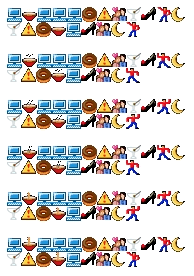
I’d love an emoji that captures my mind and split screens of Chartbeat, our site, other sites, my email accounts, my social accounts… But for this exercise, I asked my 10-year-old to try to capture what she thinks is my life into emoji. Here is her rendition:

Chartbeat, Google, my Facebook feed.
Story and community. Who are you writing for? What are you trying to say?
Digital gives us this tremendous opportunity to unbundle information and share components directly with a community of interest. The tools will change, strategies might teeter from SEO to social to email, then back again, then all of the above, but the ability to distil a development down into interesting, accessible parts remains crucial.
I have a decent BS detector. I respect stories that are complicated but respect a reader’s time and smarts. You have to learn style and formula in order to break the rules. I think about the framing of stories a lot – who will care and why? Who won’t care and how do we bring those readers in?
After spending the last few years building new products that were national or general-interest in scope, it is amazing to see the power of geography and regular readers. We have more than 500 people in our newsroom and they have deep knowledge across industries, our community, areas of interest. What’s important now is to contextualize that knowledge, across beats and generations, and embrace new forms of storytelling and new platforms in which to reach readers.
We have this amazing opportunity to be not just a pillar of this community (i.e. the fourth estate) but the glue that binds it. There are few media outlets in the country that can have such an intensely local, national and global focus.
Next week we'll hear from Greg Barber, director of digital news projects at The Washington Post, and head of strategy and partnerships at The Coral Project.
Check out [last week's interview with Alison Gow](/news/-it-is-better-to-light-a-candle-than-curse-the-darkness-q-a-with-alison-gow/s2/a565476/).
Image by Greg Kessler.