4 tools from Knight Lab to 'make information more beautiful'
Tools created by the US lab set up to promote quality journalism and storytelling

– 4 min read


Tools created by the US lab set up to promote quality journalism and storytelling

This article was migrated from an old version of our website in 2025. As a result, it might have some low-quality images or non-functioning links - if there's any issues you'd like to see fixed, get in touch with us at info@journalism.co.uk.
The US-based Knight Lab focuses on "finding ways to develop software to make information more beautiful", Miranda Mulligan, executive editor of the lab explained at an event this week.
Based at Northwestern University and funded by the Knight Foundation, the lab consists of a team of technologists and journalists "working at advancing news media innovation through exploration and experimentation", its website explains .
The lab "develops prototypes, projects and services that help make information meaningful, promote quality journalism, storytelling and content on the internet".
On Monday evening, Mulligan shared four tools created by the lab with Hacks/Hackers London , a meet up of journalists and technologists.
Timeline JS is the Knight Lab's most popular tool, used by newsrooms around the world.
It is simple to use, requiring the user to enter dates, facts and image links into a Google Spreadsheet template to create a beautiful interactive timeline.
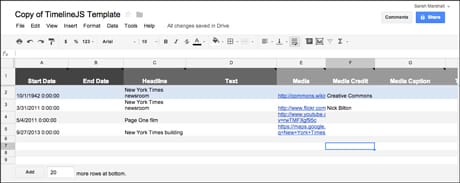
Here is an example timeline we created when we selected Timeline JS in a list of 20 tools and apps for journalists .
There used to be something here that couldn't be migrated - please contact us at info@journalism.co.uk if you'd like to see this updated!
In addition to being used to show how a news story has evolved over time, Mulligan explained how it has been used to make a portfolio and to visualise YouTube videos. It was also used to show the running order for #ONA13 , the Online News Association conference in Atlanta.
SoundCite makes text playable. It has been used by the Texas Tribune, ProPublica, Pitchfork and other news sites to create inline audio.
It is a tool to consider if you find you have a killer short clip of audio that you would like readers of a text story to hear. It may be a crowd reaction to a goal, the noise of a protest, an animal sound, or perhaps a five-second clip of an interviewee.
The screengrab below shows how a user can click on the phrase "the crowd was as large" and hear audio.

SoundCite is easy to use. All you need to do is find audio on SoundCloud or upload your own, then paste that link into SoundCite. What is really helpful is that you can select a shorter section of a longer piece of audio by setting a start time and end time for the audio. You then need to paste one bit of code within your story and another at the top of the page.
It is worth noting that SoundCite will not work on iPads and other iOS devices as it requires Flash. It is therefore good practice to avoid writing "click here" as those reading on Apple devices will not be able to.
There are some notes on the bottom of the page at this link on using SoundCite in WordPress, which is possible, although this requires a user to have an 'editor' or 'administrator' role otherwise the HTML is stripped.
Mulligan explained that SoundCite is "still in an early phase" of development.
StoryMap is a new tool launched just last week which helps "you tell stories on the web that highlight the locations of a series of events".
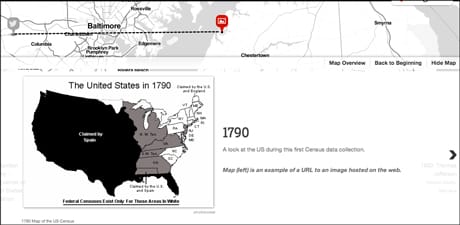
In its current alpha form it is aimed at developers as it requires some coding skills. Mulligan explained that Knight Lab is hoping early adopters will try it out and provide feedback.
She added that the lab is working on a user-friendly authoring tool aimed at journalists which she hopes will launch by the end of the year.
twXplorer was launched last month as "a better search tool for Twitter", Mulligan said. A post by Robinson Meyer on The Atlantic explains how twXplorer lets you search for a hashtag of keyword and surface:
Meyer adds that it is has great potential for surfacing content from Twitter lists "to see the most popular terms, tweets, hashtags, and links that appear in them".
Meyer says: "Twitter lists make up a great deal of my news reading regime, and this kind of auto-summary only makes them more powerful. It could be powerful, too, to make large, comprehensive Twitter lists, and let twXplorer capture and distil that large swathe. Combine twXplorer with cleverly-constructed Twitter lists, and you could control your own little battalion of news-finding bots."
Mulligan told Hacks/Hackers that the name twXplorer may be changed.
Mulligan is also editor-in-chief of Evening Edition , a simple concept which which sends out an email with five short stories at 5pm, allowing readers to catch up with the day's major news during their commute home from work. We have written about Evening Edition here.