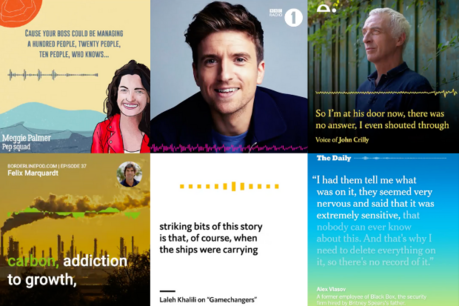
Waveforms and quote highlights can be a great way to tease out the best soundbites from your podcast on social media. We round up some of the best examples from around the media industry
Credit: Screenshots from (top) Curveball, BBC Radio 1, Tortoise Media, (bottom) Borderline, The Economist, The New York Times
This article was migrated from an old version of our website in 2025. As a result, it might have some low-quality images or non-functioning links - if there's any issues you'd like to see fixed, get in touch with us at info@journalism.co.uk.
One of the great assets of a podcast is the possibility to slice out a juicy soundbite and tease that out on social media. This can help you spread the word about your show or prompt a conversation with your followers.
How? Many news publishers create audiograms - visualisations of audio content - mainly through tools like Headliner to create funky waveforms, or Descript to highlight each word of a clip. Both tools have a freemium model, which means you can try them out at no cost.
Wondering how to get started? We rounded up some of the best examples from podcast creators to bring you some much-needed inspiration.
This is a dynamic and engaging waveform both visually and audibly. Kellie Riordan is armed with 18 years of experience at ABC News in Australia in managerial and strategist roles, and the experience shows here.
The waveforms she produces to promote her Curveball podcast are tidy and well-spaced out, uplifted by subtle background music, and is not overbearing on her strong branding. This invites the audience to go and check out the variety of episodes behind that link.
This one is all about the quote selection. Just think how tough it is to get a mass audience interested in a clip about something as niche as baseball coaching. Slate has selected such a relatable insight here that immediately clicks - and the tweet leads with that quote too.
The waveform and the subtitles are pretty basic, but they are not the priority here. They are just there to complement the quote, which is what really makes you curious about the entire conversation even if you are not a baseball fanatic.
This one is really about putting the design choices centre stage. Tortoise has gone with a long quote, nearing the minute mark, and two voices coming in and out (presenter and guest), which are colour coded so you always know who is speaking.
A striking waveform runs right across the middle of a full-sized picture of the guest. This creates loads of emphasis on just the sound quality of the clip. The narrator teases the story just enough to make you want to know more. The serenity of the background music gets you in the mood to sit down with this episode and a nice cup of coffee.
Stay with me on this one. Greg James is a really well-known presenter for BBC Radio 1. Look at how the waveform only runs over very selective parts of this clip from his show when he is talking (and not when it is playing clips from This Morning or The Teletubbies).
It is very minimalist, but it is a good example of how you can weave waveform audio in and out of social video. It does not have to be centre stage all the time, it can just be used when the host is talking very directly to the audience. This is not pushing the audience towards a link or a podcast, it just wants you to watch all the way through - and it manages that.
This is a good example of tactical and consistent theming. The Economist opts for a more unusual, pixelated-styled waveform and the music matches that digital vibe and aesthetic.
It puts the audience into thinking mode and makes them curious enough to follow the link at the end of the video.
Content Is Queen puts out a Twitter thread of short clips from a bunch of different episodes. Instead of going for a waveform, the words are highlighted in a quote as they are spoken.
A waveform would probably overcrowd the screen here, so quote highlights can be a good alternative if you are worried about sensory overload. Plus, because this is a thread, audiences can quickly sift through the different clips - only about 20 seconds each - to see if they want to dive any deeper into the show.
Mix and match
Borderline podcast
Tweet could not be found or could not be loaded.
Sometimes, you can afford to do both; have waveforms and quote highlights. Here is a good example from Isabelle Roughol's Borderline podcast which uses the two to emphasise the topic.
But there is no real plug to the show besides the name of the podcast in the top left-hand corner. There is no link in the post either. This is a longer clip with a thoughtful design choice to stimulate conversation. Agree?
We were not really going to leave out The New York Times' popular podcast, The Daily. This one speaks for itself, and simply has a high-quality clip playing on its signature colour theme. The waveform runs right across the top.
Anything else and this might be too much to watch all at once. But this simply lets you know what is featured on that daily episode, and gives you a good reason to go and check it out.
Takeaways and tips
Keep your audiogram decluttered. Less is more here, so do not overcrowd your screen with too many assets. Make sure everything is well-spaced out and everything can breathe.
For that reason, leave most of your detail and context in the post itself. You can assume people will read this - and of course, leave your podcast link here (unless you are posting on Instagram, then point people to your Linkinbio)
Your golden quote will make sense without much context.: a personal anecdote, a reference to Jeff Bezos, a funny joke. That quote needs to be understood with little prompt.
Choose colours and themes carefully. Do you want to be consistent with your brand colour or play into the topic of conversation? Which waveform style best suits the narrative you are going for?
Match the length of your clip to your desired outcome. Your sweet spot is going to be around 30 seconds generally speaking if you are trying to drive clickthrough. That means you must focus on grabbing attention and easy call to action. Those nearing the minute mark are more about creating native value on the platform and initiating conversation.