How journalists can use Muck Rack as a portfolio platform
Muck Rack, which now has 10,000 journalists on social media in its database, has recently launched a new portfolio feature for journalists to add links to their work
This article was migrated from an old version of our website in 2025. As a result, it might have some low-quality images or non-functioning links - if there's any issues you'd like to see fixed, get in touch with us at info@journalism.co.uk.
Muck Rack, a site which tracks what journalists are talking about on social media, now has more than 10,000 journalists listed in its database.
The database , which is free for journalists to use and it is paid for by charging PRs access, has recently launched a new profile feature and according to Gregory Galant, chief executive of Sawhorse Media, which launched Muck Rack in 2009, employers are checking profiles when recruiting new journalists.
Personal profiles
About a month ago Muck Rack, which was re-built and re-launched last December, launched a new feature which means journalists can customise their page and build a portfolio with links to their work.
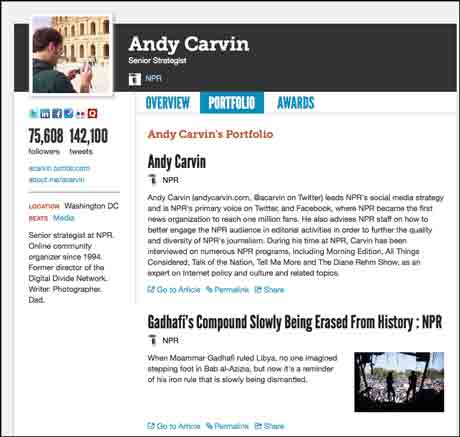
This has been utilised by NPR's Andy Carvin, who is well-known for filtering and verifying social media reports. You can see Carvin's profile at this link. "All Carvin had to do was copy and paste five URLs," Galant told Journalism.co.uk.
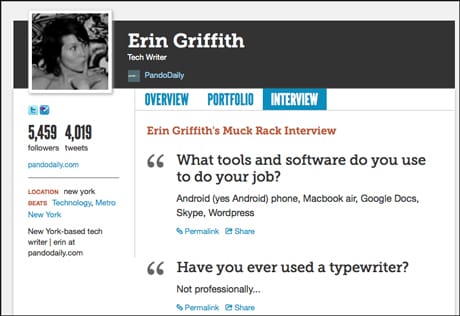
Galant also pointed out technology journalists Erin Griffith's profile which lists areas she does not cover. That includes subjects she reported on in a previous role and a line saying she does not report on "news our competitors have already covered".
Another of Muck Rack's features allows journalists to respond to interview questions. You can see an example here .
Galant was at the Online News Association's annual conference held in San Francisco last weekend and said the 'interview' feature was being used by potential employers. "Employers at ONA told me that they are using these to figure out who to hire," Galant said.
Linking data to journalists
Muck Rack indexes every tweet sent by registered journalists, and if tweets contain a link to an article they have written, that article too is indexed.
"We limit the fire hose of data to journalists," said Galant, explaining why the information is helpful to other journalists and to PRs.
The platform allows users to filter by publication, beat and other factors. For example, a search can be limited to journalists reporting on the energy sector or on politics.
Muck Rack also sends a daily email to members highlighting what other journalists are talking about on social media.
Asked if all 10,000 journalists who are now part of the database have added themselves, Galant said the vast majority had, but there has been "a bit of proactive outreach", and some social media editors feed in lists of their journalists.
Galant explained that Muck Rack verifies all journalists to ensure they are working at the organisation they state when signing up.
To mark the 10,000-journalist milestone, Muck Rack printed out a poster showing all 10,000 members, took it to journalism conference ONA and challenged people to find their own half-inch square.
Using Muck Rack you can see lists of the most-followed registered journalists at each news outlet and see who has been most active on Twitter today.
Sarah Marshall is VP Audience Strategy at Condé Nast. She leads distribution and channel strategy globally. She is also the former technology editor for Journalism.co.uk (prior to it becoming JournalismUK)