Introducing beabee: a platform to help community news outlets build membership models
The Bureau of Investigative Journalism, The Bristol Cable and CORRECTIV have come together to launch a trusted platform for the smallest newsrooms to monetise their loyal audience
This article was migrated from an old version of our website in 2025. As a result, it might have some low-quality images or non-functioning links - if there's any issues you'd like to see fixed, get in touch with us at info@journalism.co.uk.
A new European community project seeks to help smaller publications build revenue models based around membership, which in turn bolsters their reporting as well their bottom lines.
CORRECTIV, on the other hand, has mostly relied on existing software to run its membership programme but also built their own tools, like the Crowdnewsroom to enable people to contribute their experiences to investigations or gather data at a bigger scale.
"We found that other pioneers of engaged journalism and community-based revenue models ran into the same problems," says Julia Hildebrand, project lead of Beabea in an email to Journalism.co.uk, citing multiple examples from the contininent; Mediacités in France, DoR in Romania, maldita.es in Spain, Médor in Belgium and bajour in Switzerland.
"At the same time, we noticed a hunger for building more newsrooms like these first pioneers that really want to serve communities, especially when it comes to underserved communities and local communities, as more and more news deserts across Europe emerge.
"People came up to us at the Bristol Cable and CORRECTIV asking us how we were solving those tech challenges. So we wanted to make sure that for those who are starting out now, technology won't be the barrier anymore to do this work."
beabee has been tested for the best part of a year by the Bristol Cable and two local German newsrooms: Bürgerportal Bergisch Gladbach *and* 089 Wehringhausen. It is ready to bring on more beta users in different languages.
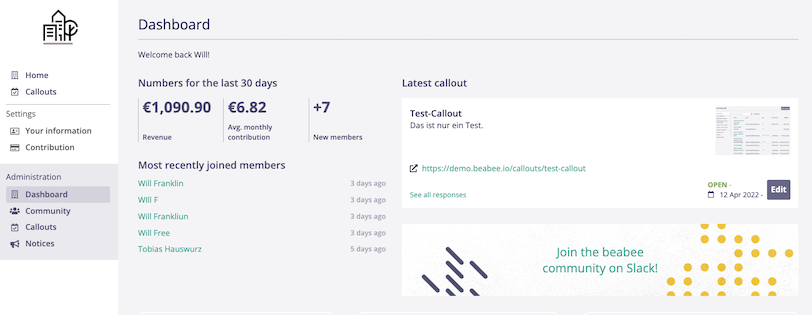
A demo of beabea admin-side
The platform will still be free for those first beta users, who can expect to need help to set up beabee on their own sub-domain, to import their existing data and set up their custom branded beabee user dashboard.
A SaaS (software as a service) version will launch later this year which will make it easier for users to get started on their own in a matter of hours. The project will also determine a fair pricing model moving forward.
Hildebrand says that the project especially wants to trial the product with very early-stage newsrooms looking to build a membership scheme, moving from spreadsheets to an actionable community database.
But in truth the applications for beabee are much broader, from enabling citizen journalism contributions or running campaigns within their communities. The platform will provide the tools to power those workflows and provide tested best practices from experienced newsrooms.
"We want to give the next generation of community newsrooms a head-start. They shouldn't have to make the same mistakes," adds Hildebrand.
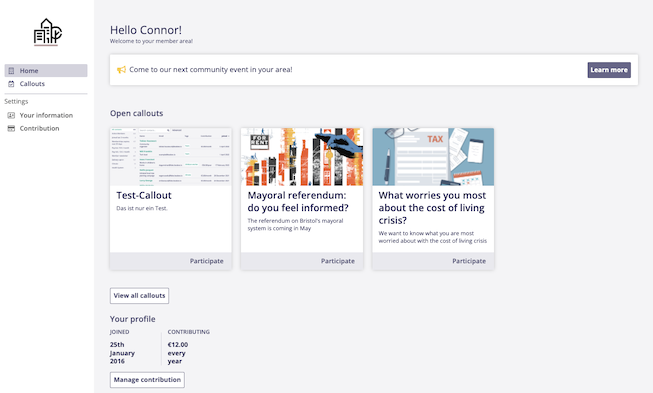
A demo of beabea user-side
Another motivation was creating a tech platform that media organisations can trust. Using big tech companies for this type of community-focused legwork can raise concerns around data-ownership, privacy-first principles or brand ownership (making community members sign up to third-party tools like Steady, Patreon or Substack).
This is why The Bristol Cable has always made its software open source, giving users the option to host it on their own servers and customise parts of it.
"These are newsrooms who see trust as their biggest asset. So they want to use tools that don't gamble with that trust and give them full control over how they treat their community data. New public interest newsrooms need new public interest technology. We can't keep relying on Facebook groups and Google forms for this kind of work," says Hildebrand.
Beabee showcased more of its features at last week's International Journalism Festival in Perugia which you can view below.