Guest post: 'The rise and rise of social discovery'
Author of the Digital News Report 2013 Nic Newman summarises the evidence and explores the implications for the industry and for the quality of our information ecosystem
This article was migrated from an old version of our website in 2025. As a result, it might have some low-quality images or non-functioning links - if there's any issues you'd like to see fixed, get in touch with us at info@journalism.co.uk.
News is becoming more social, more real-time and more mobile. These are the headline conclusions of the 2013 Reuters Institute Digital Report based on an extensive online survey of 11,000 consumers in nine countries including the UK, US, Japan and a number of key European countries.
Many of these trends are of course linked. Our survey shows a dramatic increase in the amount of news consumed via tablets and smartphones. The use of tablets for news in the UK, for example, has doubled in the last ten months from 8 to 16 per cent and weekly smartphone news usage is running at around one third (29 per cent) of our online sample.
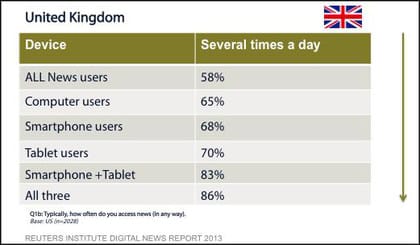
But in turn, we also find that these devices change habits and behaviour. People are accessing more frequently using these devices - and the more devices they have the more frequently they access (see chart below)
Smartphone use for news is also strongly skewed towards the younger half of the population. A third (32 per cent) of those aged 25 to 34 in the UK say the smartphone is now their main or most important way of accessing digital news. And these younger smartphone (and tablet owners) tend to share more news and discover more news through social media and social aggregators.
Our survey shows that social media is now used as a source of news by 40 per cent of the under 25s (compared with 20 per cent for our general sample). Increasingly default behaviour on smartphones is to browse social media feeds many times during the day and this is often where news is found.
The use of social aggregators like Pulse, Zite and Flipboard is also on the rise, which also seems to be encouraging the sharing of content - from brands like Buzzfeed and UsvsTh3m - that is specifically designed for a mobile, social and real time world
Social media now outstrips search amongst the young
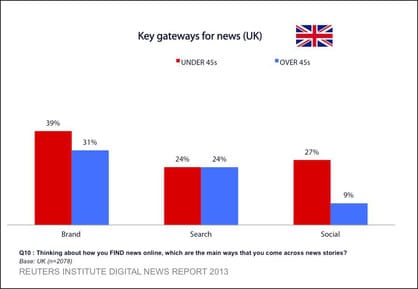
Across all our countries we see these new behaviours of discovery and distribution spreading rapidly amongst the young and now slightly older groups too. When we asked about the most important ways of finding news, the under 45s in the UK were three times more likely to use social media that the over 45s.
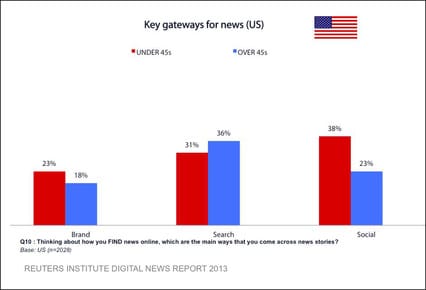
But as a sign of one possible future, it is worth looking at our comparative data from the US. Here, we see much higher levels of preference for social media discovery (as well a higher levels of sharing of news content). For the under 45s, social media is now rated more important than brand and search by our US sample.
Implications for journalism…
These changes mark a historic shift in the way news is found, consumed and distributed. Along with Google and Apple, the rise of social discovery is contributing to a world where brands are increasingly at risk of being disaggregated – with gatekeepers taking much of the value.
If brand loyalty decreases – and there is evidence in our report that this is happening amongst younger news users – it will make it even harder for the news industry to convert these social eyeballs into paying customers.
Beyond that, the move to social discovery looks increasingly hard to reconcile with an industry that is moving rapidly towards paywalls and more closed models of access. Even if metered systems let much social traffic through, just the existence of the paywall discourages the posting and sharing of content.
But there are other implications too - for journalism and democracy - as this behaviour moves into the mainstream:
If more people discover news in a raw way via unmoderated streams of content, will there still be room for the context and analysis to understand those stories?
What are the risks of exposing majority opinion to unsourced and inaccurate information – such as we saw with the aftermath of the Boston bombings and the Sandy Hook shootings? Are these trends encouraging witchhunts, intruding further on the privacy of innocent people?
Will social networks encourage more popular content; endless streams of top ten lists and celebrity news (another of the trends picked up by this year’s digital report)? Will the time spent with this content squeeze out more serious forms of journalism?
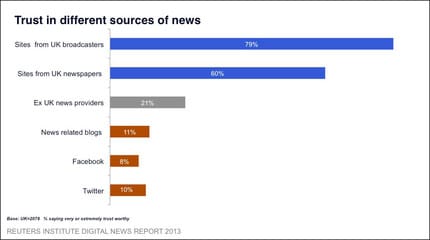
These fears are real but almost certainly overblown. Our research over a number of years suggests that social media is not replacing other forms of media but is largely used as an additional layer for access and comment. It also shows that although people are using news for discovery, they do not yet trust the information they see in social networks. Less than one in ten say they find news in Twitter and Facebook very or extremely trustworthy whilst young and old still strongly value content from mainstream media (UK figures only below)
These figures raise a number of important issues and not just for traditional media. Twitter’s move to appoint a head of news will hopefully accelerate the much needed improvement to its labelling and verification capabilities while journalists and news organisations also need to play a more visible role in engaging with these issues on social networks.
There is no room of complacency. The habits of audiences are changing fast and the issues of accuracy, ethics and context are real and pressing.
Nic Newman is author of the Reuters Institute Digital News Report. He is also a digital strategist and former controller of future media for BBC Journalism.
Nic Newman is a senior research associate at the Reuters Institute for the Journalism where he was the lead author of the flagship Digital News Report.