What newsroom leaders need to know about how product management is reshaping journalism
A new report by News Product Alliance finds that product pros have become a crucial and formal part of the newsroom, but are plotting their exit to other industries
This article was migrated from an old version of our website in 2025. As a result, it might have some low-quality images or non-functioning links - if there's any issues you'd like to see fixed, get in touch with us at info@journalism.co.uk.
Journalism exists to give people the information they need to make decisions, participate in civic life, and feel connected to their communities. Yet in 2025, traditional ways of delivering news are falling short of meeting those needs, according to the latest The State of Product Management in Journalism report from the News Product Alliance.
This comprehensive study of over 500 product professionals across 69 countries reveals that newsrooms are finally embracing product thinking, but many are still missing the mark on what makes it truly effective. It finds that audiences are scattered across platforms, trust is increasingly fragile, and technology is rapidly reshaping how people access information. Too often, journalism's value is assumed rather than clearly defined or demonstrated.
This is where product management comes in. Product is fundamentally about creating value by connecting editorial priorities with audience needs, business strategy, and technology. It's about designing services that make journalism genuinely relevant and useful in people's lives, whether that's through a daily newsletter, a membership programme, an AI-powered tool, or formats we haven't yet imagined.
The findings paint a clear picture: product management isn't just another business buzzword. When done properly, it's the connective tissue that holds modern newsrooms together, linking editorial priorities with audience needs and business sustainability.
The transformation is real but uneven
Five years ago, product managers in newsrooms were rare, often lacking formal titles or real influence. Today's landscape looks dramatically different. Nearly half of survey respondents now hold formal product positions, while another 47 per cent are doing product work informally. Two thirds of organisations report having official product teams, and 45 per cent have dedicated product executives.
But here's the crucial bit: having product people doesn't automatically translate to product maturity. The research reveals a stark divide between newsrooms that truly understand product work as strategic and those that treat it as glorified project management.
What separates thriving from struggling
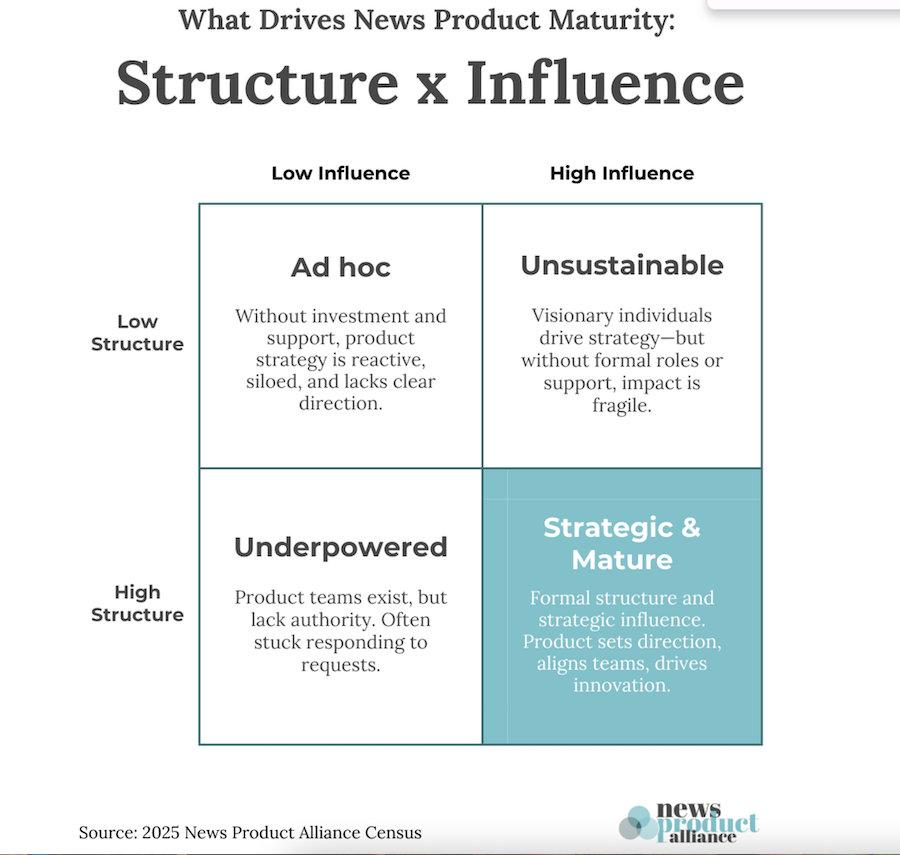
The most successful newsrooms share two critical characteristics: structure and influence.
Structure means formal roles, dedicated teams, and leadership backing. Influence means product professionals have genuine decision-making power over strategy, budgets, and organisational direction, not just the ability to tick items off someone else's to-do list.
Newsrooms that nail both elements report significant advantages across the board: better business and audience outcomes, stronger cross-team collaboration, more systematic approaches to product development, and greater recognition from leadership.
Meanwhile, organisations without proper product foundations remain stuck in reactive mode, constantly firefighting rather than building for the future.
Three steps every newsroom should take
1. Invest in real product leadership
Product isn't a support function, it's strategic. The data shows that newsrooms with both formal product teams and dedicated product executives are twice as likely to operate strategically rather than just executing other people's ideas.
This means hiring product leaders with genuine authority and giving them seats at the top table where organisational strategy is actually shaped.
2. Build proper capacity
Half of the survey respondents flagged capacity gaps as major obstacles. Too many newsrooms expect transformative results from overextended teams juggling product work alongside other responsibilities.
Practical capacity building includes dedicated time for experimentation and iteration, proper resourcing for product initiatives beyond one-off grants, clear processes for roadmap development and execution, and investment in tools and systems that support product workflows.
3. Teach people how to lead, not just manage
Knowing how to use product tools is important, but it's not everything. The best product people understand how newsrooms really work, can get different departments talking to each other, and know how to make tough calls when things get hectic.
Training should teach people how to lead across teams, understand what audiences actually want, make smart choices about priorities, and get their ideas heard by the people who matter.
The retention crisis lurking beneath the surface
Here's a worrying finding that should concern every news leader: while half of product professionals want to advance their careers in product or leadership roles, only one in three is committed to staying in journalism. Nearly half are open to leaving the industry entirely, and 15 per cent are already considering their exit.
This represents a potential brain drain of exactly the people newsrooms need most. Product professionals are often the most digitally savvy, data-literate, and strategically minded people in news organisations. Losing them can be devastating.
The solution isn't just better pay, though that helps. It's about creating inclusive cultures with clear advancement pathways and giving product professionals the autonomy and recognition their strategic role deserves.
Why this matters for journalism's future
Product management in journalism isn't about optimising for clicks or mimicking tech companies. At its best, it's about answering journalism's most fundamental question: what makes journalism essential in people's lives today?
Product professionals are uniquely positioned to bridge the gap between what audiences need, what editorial teams want to create, and what business models can sustain. They're the ones tracking audience behaviour, testing new formats, and figuring out how to deliver public service journalism in ways that actually reach and engage people.
In an era of platform dependency, subscription fatigue, and information overload, newsrooms need this connective thinking more than ever. The organisations that invest properly in product will be the ones defining journalism's future.