Newstag: A new model for 'hyper-personalised' video
The new mobile first platform lets users curate their own news video channels and donate to causes
– 3 min read


The new mobile first platform lets users curate their own news video channels and donate to causes
This article was migrated from an old version of our website in 2025. As a result, it might have some low-quality images or non-functioning links - if there's any issues you'd like to see fixed, get in touch with us at info@journalism.co.uk.
"I think the media industry was disrupted 15 to 20 years ago and while consumption and volume are going through the roof, the sustainable model is falling apart," believes Henrik Eklund, co-founder and chief executive of Newstag.
That's what he is hoping to change by developing a mobile-first video platform that brings together news organisations, NGOs and brands.
> > > > > Things are cheaper, faster or lighter, but there is no model for creating something that actually pays for journalism > > > > Henrik Eklund, Newstag > > > > Newstag
launched in June and it's currently still in beta, letting users create a personalised news channel through what it calls 'tag streams' or topics of interest, region or language.
Since launch, the site has been accessed in more than 200 countries, gathering nine million views in its first month of going public. Sixty per cent of the platform's users are under 34 and 77 per cent access it on their mobile devices.
For now, only 12 news outlets have signed up, including AP, Russia Today and Reuters, but Eklund said the aim is to "have one from every region and, hopefully, from every country in the world".
"You will have a news channel that will update 24/7 with sources from all over the world about your topics, which basically means you get, let's say, a CNN, but it's your own."
He argued the media is mostly focused on adapting to new technologies, but "there is no model for creating something that actually pays for journalism".
"Two hundred hours of video are uploaded every minute on YouTube, and at the same time, nobody is getting paid and the journalists who are really needed to make sense of all this are actually getting pushed out of the model.
"Even though there's so much more – and you could get so many more angles and better understanding – you get less," he told Journalism.co.uk.
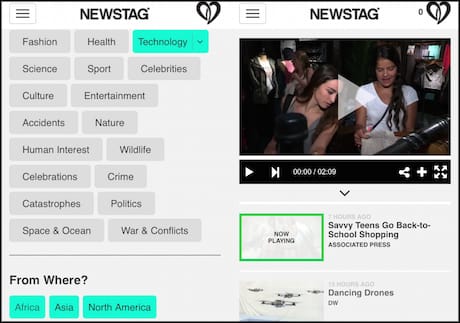
Screenshot showing how users can create tag streams on Newstag
Newstag uses a redistribution model it calls 'power' to let users donate five per cent of its revenue to specific causes and organisations, such as Oxfam, Red Cross and the United Nations World Food Programme, dependent on how regularly they use the site.
The revenue comes from brands Newstag has signed up, who can sponsor one or more tag streams created by users.
Eklund said this allows brands to "meet [consumers] in a new relationship", as they can also donate money to the same causes supported by the users. The only editorial involvement the team has is tagging the video footage as it comes in and ensuring the tags are accurate.
"You have professional journalists telling their story and they can be associated with a type of value without the brands being the ones producing the content," Eklund explained.
As people are currently visiting Newstag using their mobile browsers – what the platform was intended for – a mobile app is also in the cards.
Eklund also said data consumption is an aspect to be considered, in order to make the platform accessible even to users with smaller data packages.
"We will work closely with mobile operators and we could have packages to deliver our content and in that delivery process, we could actually pay for the data so it doesn't cost the user any data to access Newstag," said Eklund.