This article was migrated from an old version of our website in 2025. As a result, it might have some low-quality images or non-functioning links - if there's any issues you'd like to see fixed, get in touch with us at info@journalism.co.uk.
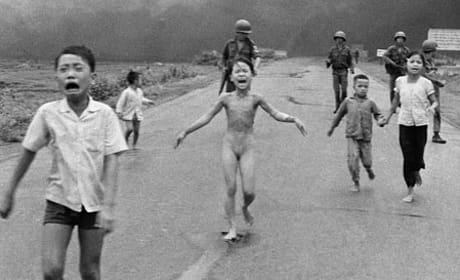
Copyright: Nick Ut
It has been 40 years since Associated Press photographer Huynh Cong
Ut, known as Nick, captured the powerful "napalm photo" in Vietnam.
The Pulitzer prize-winning image shows a nine-year-old-girl, Kim
Phuc - now a close friend of Ut's - running naked along Highway One
after a napalm bombing.
While some of the other journalists
with Ut frantically re-loaded their cameras, he managed
to secure the famous image.
But his role that day was not just as a photographer. He wanted "to
save [Phuc's] life first", Ut told Journalism.co.uk in an interview
following the 40th anniversary of the image being captured.
Reflecting on that day - 8 June 1972 - Ut said he had seen heavy
fighting in the early morning and had already taken a lot of
pictures in the area. But suddenly napalm was dropped and "I saw
the people running", he recalls. First this was adults
carrying young children. And then he saw a girl running naked with
other children, screaming.
I thought what
happened? I took a lot of pictures of her and after I took the
pictures I saw her skin coming off - Nick Ut
"I
thought 'what happened?' I ran and took a lot of pictures of her
and after I took the pictures I saw her skin coming off ... I
don't want her to die."
At this moment he put his cameras down onto the road and, with a
friend, tried to help with water.
He added: "When I took her picture and saw her skin
coming off I think 'she be die, she be die'. I said, 'oh my god, I
don't want no more pictures. I want to help her right away."
He helped Phuc get to a hospital and get treatment. And he
returned to visit her and her family the next day.
"I am really so happy she was still alive and the picture can
tell her story."
He added: "The picture moved all over the world. They never
retouched any picture ... AP said no, we don't have to do
that."
He said his boss was keen to send the image to AP in New York
straight away. And the picture soon travelled across the world, he
said.
"People were calling me and saying 'Nicky, thank you so much,
the picture'. A lot of American soldiers came
home early because of the picture.
On assignments,
in Hollywood, people know who I am ... I'm so happy, I'm very proud
of my photo - Nick Ut
"On assignments, in
Hollywood, people know who I am ... I'm so happy, I'm very proud of
my photo."
And the relationship between photographer and subject has remained
strong over the years, he said.
"I'm always thinking about her a lot. I call her once a
week. I talked to her like two days ago."
But the memories of that day 40 years ago are also strong. "I look
at the picture, I cry sometimes," he said.
Ut was wounded three times himself while covering the Vietnam war.
He tells us: "I really don't believe how I covered the war in
Vietnam. It was so young for me at that time".
Ut's brother, who was also a photographer for AP, had taught him
the trade "as a young man". And Ut ended up joining the
AP just after his brother's death.
Today, more than 40 years after starting to take photos for
AP, Ut continues to work for the news agency, having
transferred to the Los Angeles bureau in 1977.
"I plan maybe retiring in a couple of years, maybe next year, who
knows," he says. But for now, "I enjoy the job so much".