RISJ report: Video is expanding the podcasting audience, not replacing it
Big publishers are launching audio-only subscriptions, while podcast specialists turn to events, merch, and bonus content to beat paywall resistance

A one-minute read, every weekday. Unsubscribe anytime.
No spam. Unsubscribe anytime.
Podcasting is undergoing a transformation, with video rapidly becoming as important as audio for news audiences. According to a new Reuters Institute report, newsrooms are reimagining their podcast strategies as listeners increasingly switch between watching and listening, often choosing whichever format best fits the moment.
The report, 'The Changing Shape and New Economics of News Podcasting: From listening to watching, from podcasts to shows', draws on qualitative interviews and survey data from the US, UK, and Norway. It highlights a major shift in how news podcasts are produced, discovered, and monetised.
Video is not replacing audio, but rather expanding the overall podcast audience. It points to industry research indicating that 26 per cent of Americans aged 12 and over now both listen to and watch podcasts weekly — twice as many as those who only listen (13 per cent) and far more than those who only watch (6 per cent).
The shift is being driven by both audience demand and platform innovation. Major platforms such as Spotify, YouTube, and Apple have invested heavily in video podcasting, making it easier for users to switch between formats and discover new shows.
What determines whether someone opts for video on or off? Part of it is the news moment, the window in their day to engage with content. But it also comes down to underlying preferences and that video tends to be a preferred medium for entertainment.

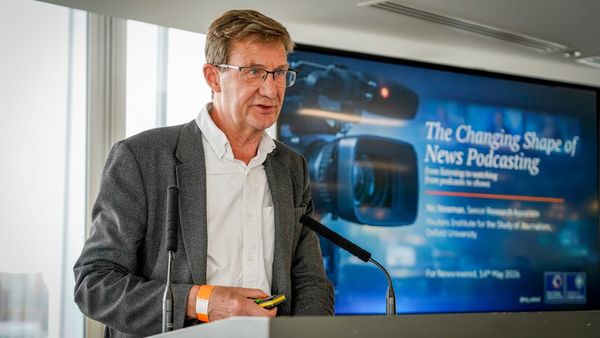
Nic Newman, lead author of the report, said:
When deciding whether to watch of listen people often choose the format that suits the moment they’re in. If they want companionship while driving or walking, audio works beautifully. If they want personality, reaction, or deeper engagement in the evening, they often choose video.
Publishers are responding by moving away from expensive, narrative-driven series and focusing on personality-led, conversational formats that work across both audio and video.
Publishers experiment with video, but approaches vary
The report performed in-depth interviews with 16 major news publisher and podcast-first news companies. It revealed a range of responses to the video podcast boom.
Some, like the New York Times and Guardian, are selectively adding video to certain shows - especially those with strong personalities or chat formats - while keeping flagship narrative series audio-first. Others, such as Die Zeit and The Economist, are experimenting with short video clips for promotion and discovery, but remain cautious about converting their entire portfolios due to concerns about cost, workflow complexity, and the risk of losing audio’s intimacy.
Meanwhile, publishers like the Financial Times and Schibsted are using video as a tool for audience growth and engagement, but favour formats that naturally lend themselves to visual storytelling. Across the board, there is a recognition that not every podcast benefits from a video treatment, and that editorial teams must balance innovation with the unique strengths of audio.
The report also notes that this transition is forcing newsrooms to rethink their workflows. Audio, video, and social teams are increasingly collaborating to produce multi-modal content, including full episodes, video versions, social clips, and written articles. While advertising remains the main source of revenue, publishers are experimenting with hybrid models that include live events, merchandise, and bonus content.
Despite the opportunities, the report warns that not all publishers are moving at the same pace. Some are embracing video across all their shows, while others are more cautious, converting only certain formats and keeping narrative podcasts audio-only.
The full report is available from the Reuters Institute for the Study of Journalism.
Want to know more? Nic Newman presents more insights of this report at our upcoming Newsrewired conference on 14 May at News UK. Book now, only a few tickets remain.
This article was drafted by an AI assistant, before lots of human prompting and editing