Why user needs have the power to stop audiences feeling overwhelmed by the news
A new report by FT Strategies and smartocto reveals how newsrooms are increasing relevance, engagement and revenue by focusing on why readers consume news rather than what journalists think is important
This article was migrated from an old version of our website in 2025. As a result, it might have some low-quality images or non-functioning links - if there's any issues you'd like to see fixed, get in touch with us at info@journalism.co.uk.
In today's digital media landscape, understanding what readers actually want has become essential for newsroom survival. A new report by FT Strategies and editorial analytics provider smartocto outlines how the user needs model can help news organisations create more relevant content that resonates with audiences and drives revenue.
What is the user needs model?
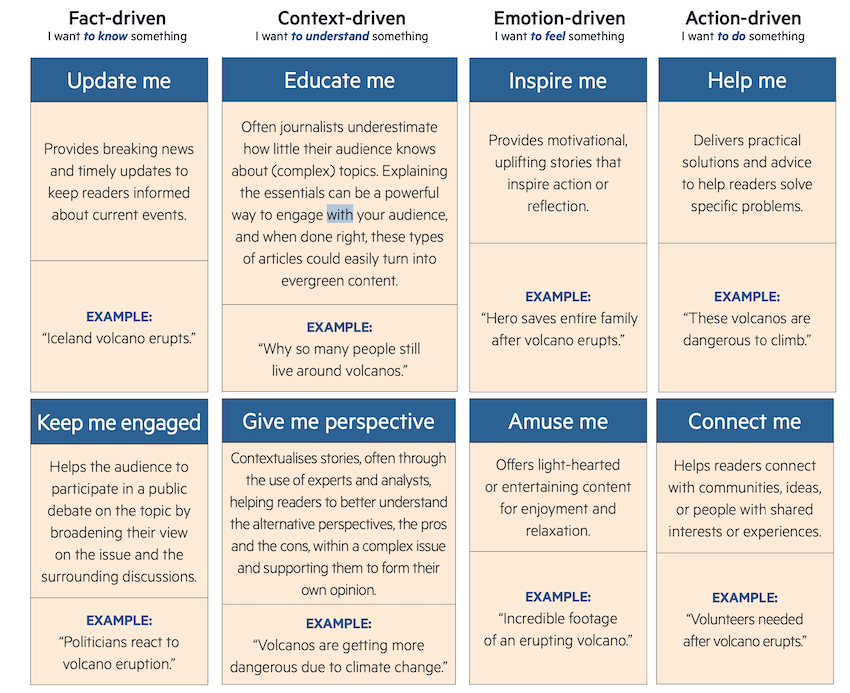
The model categorises why people consume news into eight distinct needs across four angles.
Courtesy: FT Strategies/smartocto
The fact-driven angle addresses readers’ need to be updated with breaking news.
The context-driven angle covers their desire to be educated through explanations and to gain perspective through analysis.
The emotion-driven angle fulfils the need to be inspired by motivational content, amused by entertainment, and kept engaged through participation.
The action-driven angle responds to the need for practical advice and community connection.
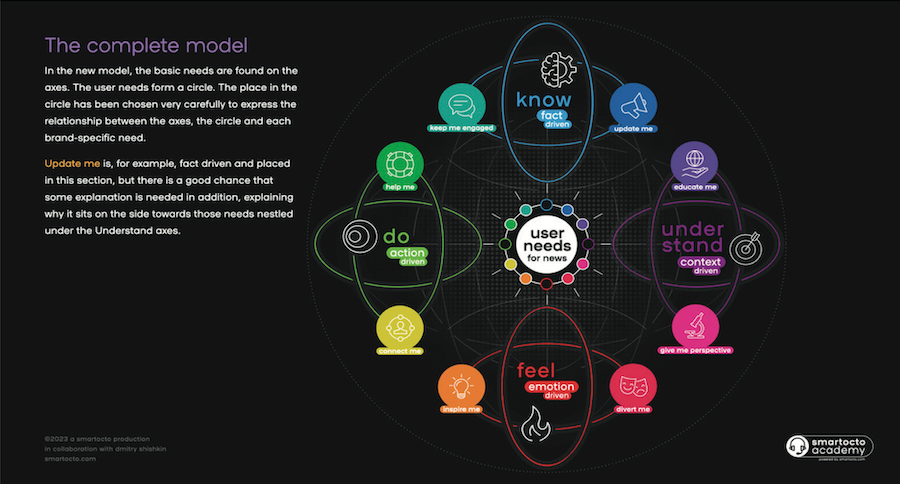
Courtesy: smartocto
Rather than focusing solely on what journalists think is important, this framework helps newsrooms understand and address the specific needs driving audience consumption.
Why does this matter?
According to the report, today's readers are "demanding, selective, and overwhelmed by choices." They do not just want facts; they want to understand why news matters, how it affects them, and what they can do about it.
Stories that address these specific needs create stronger relationships with readers, driving engagement, loyalty and revenue.
The report highlights how publications have benefited from implementing the user needs model.
Serbian news portal Blic experimented with their leisure section 'slobodno-vreme'. Their editorial team discovered that four in five poorly performing "give me perspective" articles featured negative emotional framing in headlines, which seemed to deter reader engagement.
It also noticed the lack of "inspire me" stories with positive emotional content.
Blic's word cloud of negative emotions overrepresented in the leisure section slobodno-vreme
Armed with these insights, Blic made strategic adjustments to its content approach. It reduced the production of negatively framed "give me context" stories and increased the creation of "inspire me" stories with a more positive emotional connotation.
The results were remarkable. Average reads for "inspire me" stories increased by 3.7 times, while "give me perspective" stories with positive framing saw an even more dramatic improvement, with average reads increasing by 4.9 times.
The experiment showed how relatively simple adjustments to headline strategy and emotional framing can substantially boost engagement. It provided evidence that data-driven editorial decisions based on user needs can yield dramatic improvements in content performance.
Swiss agricultural publication BauernZeitung found that 90 per cent of its content was fact-driven or context-driven. By increasing emotion-driven stories, which readers spent more time with, its top-performing emotion-driven article achieved 15 per cent higher page views.
Additionally, emotion-driven content attracted 45 per cent new visitors. Engagement improved across different sections, with a 56 per cent increase in average page views in 'agrarpolitik' (agricultural policy) and 33 per cent increase in 'landleben' (country life) sections.
How to implement the user needs model in your newsroom
The report outlines four key steps:
1. Set the foundations
Training staff to understand user needs helps them view content creation from the audience’s perspective. Implementing analytics tools allows you to track how content meets specific user needs. Ongoing monitoring of metrics like page views, attention time and article reads provides valuable feedback for adjusting your strategy.
2. Define your most relevant user needs
Select the needs that align with your brand and audience profile to create content that resonates more deeply. For example, lifestyle publications might focus on inspiring readers, while business publications might prioritise providing perspective. Establishing clear key performance indicators ensures you can measure impact in alignment with your overall goals.
3. Track and monitor article performance
Create a structured tagging system aligned with user needs to assess which content types resonate most with your audience. Use dashboards and notifications to maintain a broad view of content performance across different categories. Generate comprehensive reports that track improvements over time rather than focusing solely on standalone metrics.
4. Develop data-driven experiments
Form hypotheses about which combinations of user needs, topics and formats work best for your specific audience. Test adjustments to your content mix based on engagement data to refine your approach. Set monthly goals for content output aligned with your key performance indicators to track progress consistently.
By following these steps, newsrooms can create content that truly meets readers' needs while fostering engagement and loyalty. The most successful implementations recognise that user needs work best when considered alongside appropriate topics and formats, creating a strategic alignment between what audiences value and what newsrooms produce.