Ten talking points from the Reuters Institute Digital News Report 2025
Smartphone-driven consumption, creator-led alternative media, a global divide in AI adoption - it's all chop and change in the news industry and here's what your newsroom needs to know
This article was migrated from an old version of our website in 2025. As a result, it might have some low-quality images or non-functioning links - if there's any issues you'd like to see fixed, get in touch with us at info@journalism.co.uk.
The Reuters Institute has published its 14th annual Digital News Report, offering ground-breaking insight into the trends shaping newsroom strategy, audience behaviour and tech disruption.
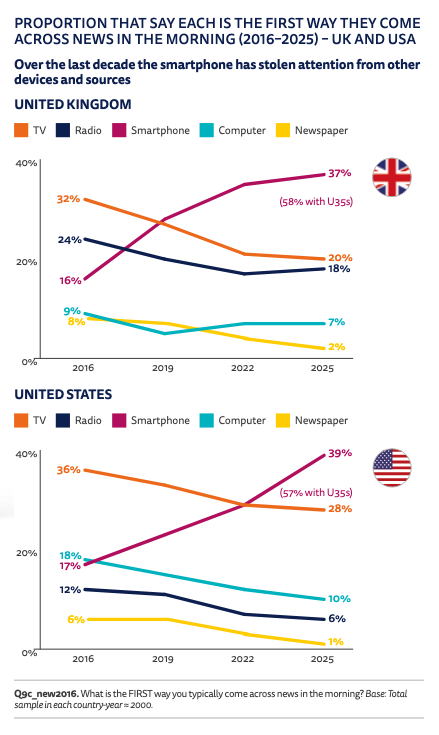
The smartphone revolution is complete. UK (37 per cent) and US (39 per cent) enjoy strong markets for mobile news as a first encounter news each day, displacing traditional morning TV, radio, and newspaper routines.
This shift fundamentally changes news consumption from scheduled, shared experiences to personal, on-demand, and fragmented ones throughout the day.
One key statistic:
More than half of under-35s consume news via mobile in the UK (58 per cent) and US (57 per cent).
So what?
Publishers must optimise for interrupt-driven, multitasking consumption rather than appointment viewing. This requires rethinking everything from story length, to notification strategies, to homepage investment.
2. Local news loses community information role to platforms
In a nutshell:
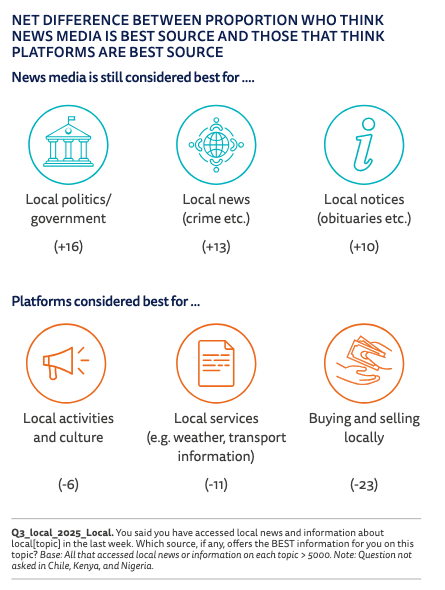
While audiences still prefer traditional media for local politics and breaking news, they increasingly turn to platforms for community information. Social media and search engines are now seen as better sources for local activities (-6 net preference), services like transport information (-11), and buying/selling locally (-23).
This represents the erosion of local media's traditional role as the comprehensive community hub, leaving them to compete primarily on original reporting and breaking news.
One key statistic:
Platforms beat news media by 23 percentage points for local buying/selling information, showing how digital tools have captured previously media-dominated territories.
So what?
Local publishers must focus on their remaining strengths - original reporting, local politics, and breaking news - while acknowledging they've lost the broader community information role to more efficient digital platforms. Survival requires specialisation, not attempting to be everything to everyone.
Individual content creators now compete directly with news organisations for audience attention and political influence. From Joe Rogan reaching 22 per cent of Americans weekly - disproportionately young men - to Hugo Travers reaching comparable levels with under-35s in France. Personalities are building media businesses that bypass traditional editorial processes.
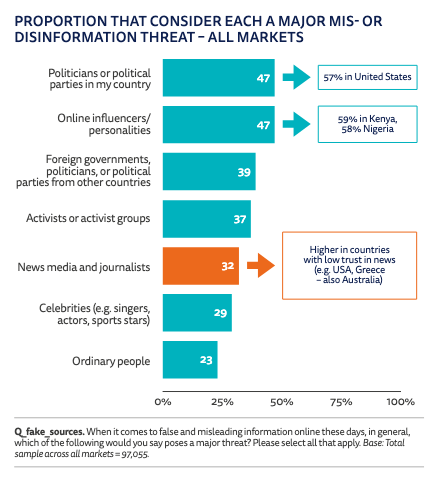
The paradox is that while influencers gain popularity, nearly half of audiences (47 per cent) view them as a likely source of mis- and disinformation - just as prominent as politicians.
One key statistic:
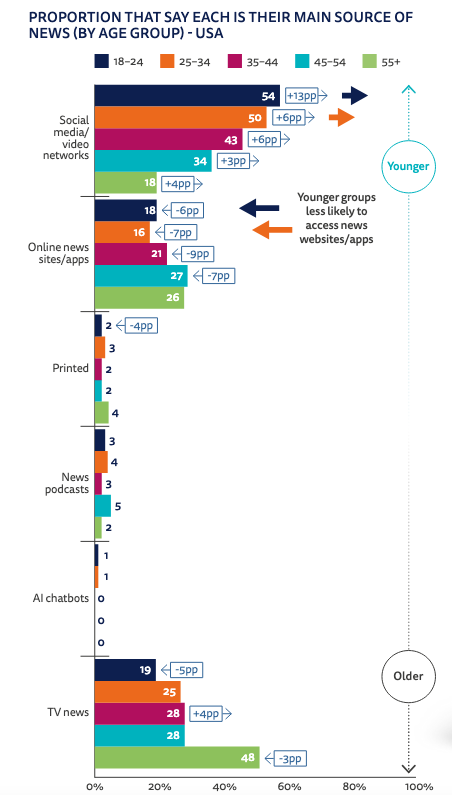
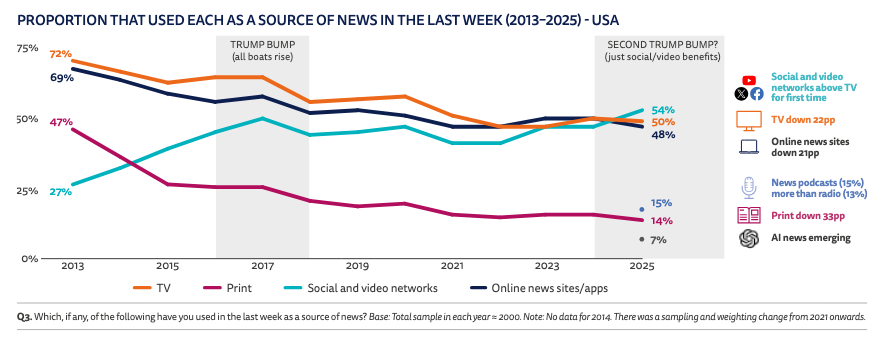
In the US, social media and video networks (54 per cent) have overtaken both TV news (50 per cent) and news websites (48 per cent) as news sources for the first time.
So what?
The creator economy represents both an existential threat and a potential model for journalism's future. Traditional outlets must decide whether to compete by embracing personality-driven content or double down on their editorial, investigative, and fact-checking advantages as differentiators.
4. Trust stabilises at dangerously low levels
In a nutshell:
Global trust in news has plateaued at 40 per cent for three consecutive years after years of decline, but this masks dramatic regional differences. Trust ranges from 67 per cent in Finland to 22 per cent in Hungary and Greece. The UK has seen a particularly steep 16-point decline since 2015 to just 35 per cent.
When verifying potentially false information, audiences increasingly use multiple sources including social media and AI chatbots alongside traditional outlets, indicating a "flatter" trust hierarchy.
One key statistic:
58 per cent of people globally worry about distinguishing real from fake news online, with greatest concern in Nigeria (84 per cent), South Africa and US (both 73 per cent). Nigeria and US are both increasing, too.
So what?
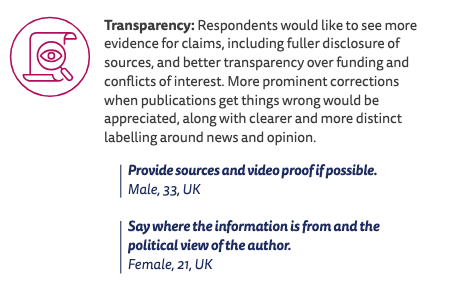
Low trust creates opportunities for alternative voices but undermines democracy's information infrastructure. Publishers need radical transparency and must prove value through accuracy, impartiality, and original reporting - though in polarised societies, these concepts themselves are contested.
5. News avoidance reaches crisis levels amid information fatigue
In a nutshell:
40 per cent of people worldwide now sometimes or often avoid news - matching the highest level ever recorded and up from 29 per cent in 2017.
The reasons are universal: negative mood impact (39 per cent), feeling overwhelmed (31 per cent), too much conflict coverage (30 per cent), and powerlessness to act (20 per cent).
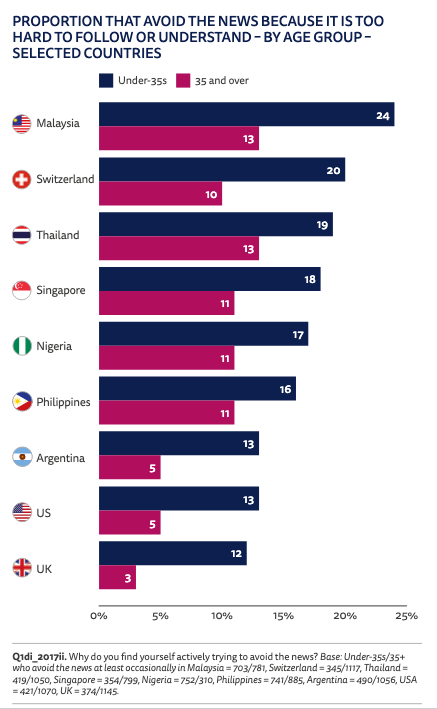
Younger audiences increasingly find news "too hard to understand," while AI-generated content adds to concerns about information authenticity and overload.
One key statistic:
In the UK, under 35s are four times more likely (12 per cent) to avoid the news because they don't understand it than over 35s (3 per cent).
So what?
Publishers need to reconsider not just what they cover, but how they cover it. Explainer content remains a clear area of need. Other solutions may require industry-wide changes to tone, relevance, and format, including "constructive journalism" approaches and user-needs methodologies.
6. Social video consumption explodes globally
In a nutshell:
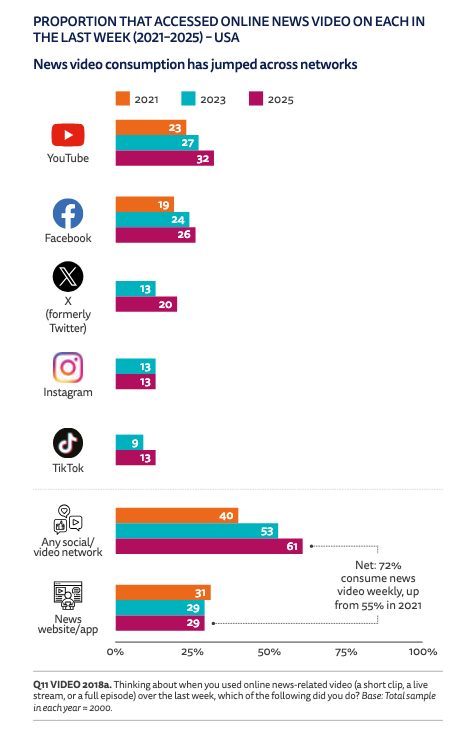
Video news consumption grew from 67 per cent to 75 per cent globally in just two years, with social video jumping from 52 per cent to 65 per cent. Countries like India, Thailand, Philippines, and Kenya now prefer watching over reading news, driven by cheap data, smartphone penetration, and changing content preferences.
Most consumption happens on third-party platforms (61 per cent) rather than publisher websites (29 per cent), fundamentally changing the economics of video journalism.
One key statistic:
TikTok has become the fastest-growing news source globally (+4 percentage points), reaching 49 per cent in Thailand and 40 per cent in Malaysia.
So what?
Video represents both the future of news consumption and a resource allocation crisis for publishers. Video production is expensive and labour-intensive, but increasingly necessary for audience reach. This trend appears permanent and generational, forcing fundamental newsroom restructuring worldwide.
7. Subscription growth hits ceiling as payment resistance hardens
In a nutshell:
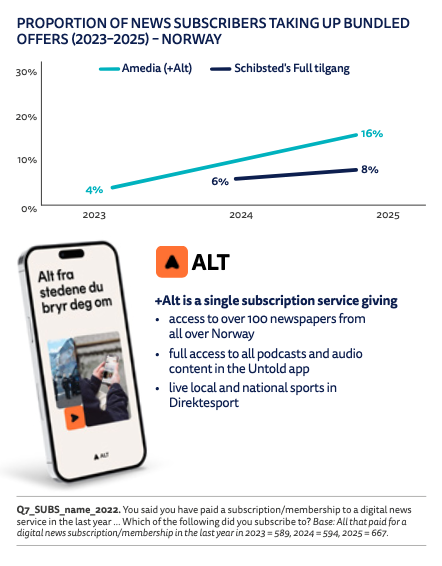
Despite industry focus on reader revenue, only 18 per cent of people across 20 wealthy countries pay for online news - a plateau after doubling over the past decade. Payment varies dramatically from 42 per cent in Norway to 6 per cent in Croatia, suggesting the 'willing payer' market has been largely exhausted.
Major markets show minimal growth potential: Germany (13 per cent), Japan (10 per cent), UK (10 per cent), indicating subscription-first strategies may have reached natural limits.
One key statistic:
Across 20 markets, 71 per cent of non-payers say none of the proposed flexible payment options would encourage them to pay.
So what?
The subscription-first strategy may have reached its natural limits outside of a few high-trust, high-income markets. Publishers need alternative monetisation strategies - whether through AI licensing, platform partnerships, bundling with lifestyle content, or completely different value propositions beyond information access.
The gap between under-35s and over-35s in news consumption has become a chasm. Younger audiences prefer social media (44 per cent of 18-24s globally), video content, and informal presentation, while older groups maintain preferences for TV, websites, and text-based news.
This represents fundamentally different expectations about information format, source authority, and consumption context that cannot be bridged with a single product approach.
One key statistic:
44 per cent of 18-24 year olds globally say social media/video networks are their main news source, compared to just 20 per cent of those 55+.
So what?
Publishers cannot serve both audiences with the same product strategy. They need either distinct approaches for different age groups or must choose which demographic to prioritise, as the consumption patterns and expectations are increasingly incompatible.
9. AI adoption creates global innovation divide
In a nutshell:
Artificial intelligence acceptance varies dramatically worldwide, creating different competitive landscapes. Weekly AI chatbot usage for news ranges from 18 per cent in India, to 3 per cent in the UK. Comfort with AI-generated news spans from 44 per cent in India to 11 per cent in the UK.
This divide affects not just audience acceptance but publisher innovation speed, with AI-accepting markets potentially gaining significant advantages in efficiency, personalisation, and cost reduction.
One key statistic:
7 per cent of people globally use AI chatbots for news weekly, but this rises to 15 per cent among under-25s, indicating generational change ahead.
So what?
The AI divide will reshape global media competition over the next decade. Publishers in accepting markets like Asia and Africa may leapfrog traditional Western outlets through AI-powered efficiency and personalisation. Success requires matching AI capabilities to local audience comfort levels rather than following universal strategies, while being transparent about AI use to maintain trust.
10. Breaking news alerts become critical battleground for direct relationships
In a nutshell:
Mobile news alerts represent one of the few remaining direct publisher-audience relationships outside platform mediation. Leading brands like BBC News reach 46 per cent of UK alert users (approximately 4 million people per notification), making alerts one of their most powerful digital channels.
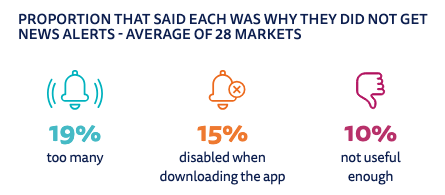
However, 43 per cent of non-users have actively disabled alerts due to overload, while aggregators and AI summaries threaten to mediate even this direct connection.
One key statistic:
Weekly news alert usage ranges from 42 per cent in South Africa to 10 per cent in Germany, with trusted breaking news brands dominating in most markets.
So what?
Alerts represent a critical direct connection in an increasingly platform-mediated world. Publishers must perfect their alert strategy - frequency, timing, relevance, and personalisation - as it may be their last reliable way to reach audiences without algorithmic interference or platform revenue sharing.
We used Claude AI to summarise parts of the report before it was edited by a human.