This article was migrated from an old version of our website in 2025. As a result, it might have some low-quality images or non-functioning links - if there's any issues you'd like to see fixed, get in touch with us at info@journalism.co.uk.
There used to be something here that couldn't be migrated - please contact us at info@journalism.co.uk if you'd like to see this updated!
Why have 800 US newspapers signed up with Google's AdWords Print Ads system to organise their print advertising, asked keynote speaker Moritz Wuttke, CEO Asia & China of media sales company Publicitas .
"So now, with one system you can buy [advertising in] 800 newspapers on one site. Nobody, in the whole of the United States was capable [of] that. Did
we need Google to do that? No.
"This is great stuff, but do we need Google to explain to the community why newspaper advertising is good?"
It's time for newspapers to stop putting 'all their ads in one basket' and start challenging Google, he said.
Newspapers should think about working with individual advertising
partners and work with more than one at a time, he said.
General Motors (GM), Comcast, Dell and 'other huge brands' are spending an enormous amount of money on trying to influence micro-bloggers on sites like Twitter and Plurk , Wuttke said.
Microblog sites, social network sites, and instant messenger sites have strong news brands themselves, he said.
A newspaper website recently launched in China only used 20 per cent of its budget on traditional advertising, compared with an 80 per cent spend on microblogging.
"And that is a newspaper publisher who is launching a website," he said.
Newspapers need to regain advertising spend from such non-media companies and realise that they already have the very information about audiences that advertisers want to find through search and microblogs.
To overcome this competition newspapers need to copy Google and other online sites, by looking at the sales channel and pricing model, creating new sales products and sticky online content.
"Google teaches us something (...) and we should know about it," he said.
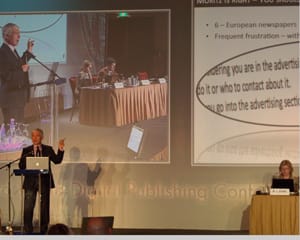
Eamonn Byrne, business director of the World Association of Newspapers (pictured left), told Journalism.co.uk that while 'there needs to be a correct separation between editorial and advertising', their definitions have shifted.
"Digital and online has changed all that [traditional] thinking and there are quite proper collaborations to be made."
Magazine consumers for example, he said, have happily accepted the idea of the advertorial.
"Your everyday journalists - increasingly less so, but still to a degree - see themselves as having an interaction with a higher power and having nothing to do with the marketplace.
"They need to sit down with advertising [departments] and discuss the objectives and rules, that work for the consumer, the journalistic ethic and the advertiser," he said.