'We must consider the web a patch' – Q&A with Ramaa Sharma
BBC World Service social media editor Ramaa Sharma shares her thoughts on the skills needed in the industry today and her advice for building a successful media career
This article was migrated from an old version of our website in 2025. As a result, it might have some low-quality images or non-functioning links - if there's any issues you'd like to see fixed, get in touch with us at info@journalism.co.uk.
Every week we ask a leading figure in digital news about their work, their career and what it takes to be a journalist in the 21st century.
Our guest this week is Ramaa Sharma , social media editor at BBC World Service, who gives us an insight into her career at the public service broadcaster and advice on what it takes to be successful as a journalist today.
What is your job title and what does that mean?
I am the social media editor for the BBC World Service. The World Service is made of 28 language services and the English radio network. Collectively these services reach 210 million people around the world each week. I am responsible for coming up with plans on how these language services can bring our journalism to new and existing users who prefer to consume news on social media platforms.
In practical terms, this includes everything from bringing in new knowledge, drawing up business plans, to helping editors change their practices to accommodate innovation and new ways of working.
How did you get started in journalism/the industry?
I think I have always loved storytelling. I was quite academic at school and remember a teacher muting journalism as a possible route for me. I was not quite sure whether it was the right option for me, so I did lots of work experience to actively find out.
I presented shows at community radio stations, wrote for a local paper and served ill-made cappuccinos at a local internet cafe too. Who knew all of that would dovetail so acutely someday!
What do you most look forward to at the start of your day?
The first thing that comes to mind is the sense of pride I feel when I walk through the doors of New Broadcasting House. Forgive me for gushing, but the BBC is a pretty special place, delivering a very important service.
Twenty eight different cultures reside on the floor I work on, and no one person is the same and every language service so very distinct.
They say there comes a point in your career when the decisions you make about new opportunities that come your way hinge on who you would end up working with. I am sure I have been at the BBC for as long as I have (13 years) in part because of the awesome and generally super smart people I work and have worked with all this time.
What does a normal day look like for you? In emoji.
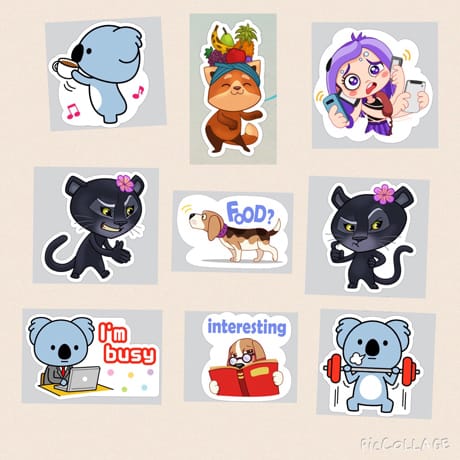
Permission to use Stickers instead? I’m more a stickers kind of gal – the sillier the better.
What three tools or apps do you use the most for work?
As you would expect I am on them all. Facebook, Twitter, Instagram, Pinterest, as well as chat apps: WhatsApp and Viber. Recently, I’ve been trying out Super too. Super has not attracted mass market appeal yet but I do think they are on to something in conceptual terms.
I say this because it does feel like there is space for an experience/app/platform that allows users to express themselves a lot more creatively than they can now. Snapchat I would say is also onto that as an idea.
Apps that help me keep organised and stay up to date include Evernote, Google Docs for sharing, Nuzzel, Feedly and the BBC News app of course.
What would you focus on if you were training as a journalist now?
Alas if only it was one thing! To be a journalist today I think, in addition to being a fine journalist, liking technology or at least not being afraid of it would help.
In addition:
multimedia skills;
understand data and how to read it well (even if you’re not a numbers person like me);
writing skills, read and write a lot and get lots of feedback;
spend time networking online and offline (even if you are a bit shy – yup, me);
consider a specialism that is both of interest to you and the world and ensure you learn how to 'market' it.
Not much then :/
What skills do you think are important to your role?
organisation – I am perpetually juggling;
communication – ability to convey ideas and plans to a cross-section of people from different disciplines and cultures;
influencing and persuading skills, because innovators tasked with delivery are essentially change agents in disguise;
creativity for problem solving but also for driving innovation;
skill of knowing when to be inspiring, empathetic, firm, collaborative – so that’s leadership.
What has your current job taught you about the industry?
That good journalism is required now more than ever. We have to find ways to ensure it reaches our audiences. We must consider ‘the web‘ a patch when we are newsgathering.
What would you say to someone applying to work at your organisation?
It’s a tough time for the BBC at the moment and there is no denying that. But that need not be a reason not to apply for jobs that come up or seek out opportunities. All I would say is be sensitive to the mood music and empathetic with the people you might be approaching because you never know what they might be dealing with.
What is the best piece of advice you have ever been given?
I hoard advice so this is a tough question. One piece of advice that was very poignant at the time came from one of my long-standing mentors, who has a huge amount of experience in conflict management.
He said to me that people on the whole tend to be quite conflict averse. Yes, even journalists at some point. This is because often in a difficult situation it’s far easier to stay silent or pretend there isn’t a problem. The trouble is, he said, often the easiest solution is not necessarily the best course of action and that a difficult conversation is necessary in order to tease out a better, creative and mutually agreeable outcome.
In short, I learnt to feel less afraid and more open to that slightly uncomfortable place we can find ourselves when we’re in disagreement whether at home or at work – this in order to make better decisions for the long run.
For more advice from Ramaa, check out this video from the Good Person To Know YouTube channel.
Next week we'll be hearing from Glen Mulcahy, innovation lead at RTE. In the meantime have a look at our previous Q&As with, among others, the LA Times's Mitra Kalita and Trinity Mirror's Alison Gow .