Workplace wellbeing interventions: what works, what doesn't and why?
Healthy work culture trumps a Headspace subscription when it comes to improving employee's mental health, finds a research paper by University of Oxford. But proper management is alien to many newsrooms
This article was first published on 31 May 2024 and it has been edited and updated on 14 November 2025
It is based on a discussion at a past Newsrewired event. Our Newsrewired conference returns on 26 November 2025 in London. Check out the full agenda and book your ticket now
The key finding of the research was not too surprising: there is no evidence that individual interventions, like wellbeing apps and relaxation classes, improves employee's mental health. It is organisational change which makes the difference.
This holds true for general workplaces. But what about newsrooms? The mental health conversation may have come a long way in the industry, but these are workplaces with a long history of macho environments, managers without managerial training and journalists reluctant to accept help in fear of limiting their career prospects.
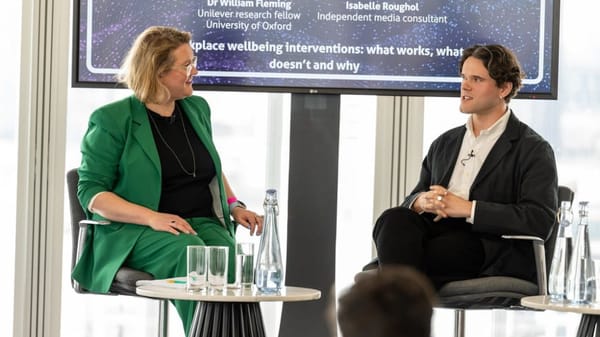
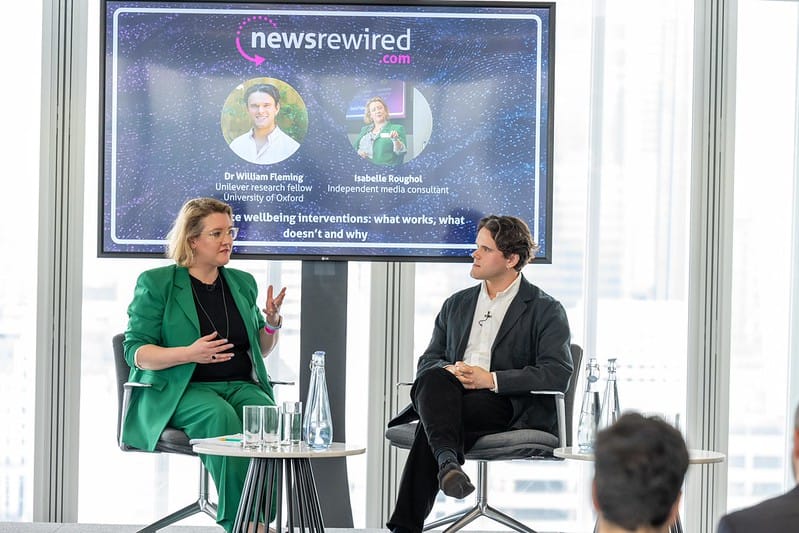
Isabelle Roughol in conversation with Dr William Flemming, Newsrewired May 2024
“We need to stop thinking about our people as an optional expense. Having a budget for raises every year is not optional. It is a part of running a business. And if you do not have it, there is an issue with how your business is being run and you have to look at your budget again."
She was speaking at last year's Newsrewired conference (22 May 2024) in a conversation with the author of the aforementioned research paper Dr William Fleming, a Unilever Research Fellow at the Wellbeing Research Centre at the University of Oxford. He provided some lessons in applying his findings to the news industry.
Why don't mental health initiatives work?
Around 70 per cent of UK organisations have adopted mental health and wellbeing programmes for staff – think mindfulness apps, resilience training, and time management workshops.
Trouble is, as Dr Fleming's research shows, these individual-level interventions have little to no measurable impact on staff mental health for two key reasons:
There's a mismatch between demands and resources There's a suite of stressors – workload, staffing, or management quality – but no tangible way to enforce solutions.
Surface-level solutions Said solutions are individual-level – mindfulness programmes, resilience and stress training, time management, corporate volunteering – and while they offer short-term relief, they don’t fix underlying issues such as poor management, lack of role clarity, or inadequate pay.
Dr William Flemming, Unilever Research Fellow, the Wellbeing Research Centre at the University of Oxford, speaking at Newsrewired in May 2024
So, what actually works?
Invest in good management
Promote managers with strong social skills, not just technical expertise.
Train managers to support, develop, and give clear feedback to their teams.
Build feedback systems and clear performance review processes.
Redesign work, not just perks
Review job roles, demands, and workflows with staff.
Adjust workloads and clarify expectations.
Consider job rotations to prevent burnout, especially in high-stress roles. "You can think in terms of rotations, which also develops additional skills in wider, supportive roles," suggests Fleming.
Formalise peer support
Encourage peer and colleague support networks — these can be informal or structured.
Create safe spaces for staff to share challenges and solutions.
Set boundaries on urgency
Challenge the culture of constant urgency – especially self-imposed urgency. "A lot of urgency is artificial, it does not necessarily need to be there," says Fleming.
Limit out-of-hours notifications and encourage staff to disconnect when off duty. Roughol notes: "My message to the team was: I am always available for you, but call. It is crazy how I got maybe one call a year. People realise that pseudo-emergencies are exactly that."
Recognise and reward teams, not just individuals
Move beyond bylines and awards. Celebrate team achievements and behind-the-scenes roles.
Develop internal recognition schemes for all contributors, including those in audience, product, and editing roles. "Recognition at work is one of the core drivers of job satisfaction," says Fleming.
Prioritise career progression and pay
Build clear career ladders and regular one-on-ones.
Budget for annual raises as a non-negotiable business expense. “Having a budget for raises every year is not optional. It is a part of running a business,” says Roughol.
Make career development and fair pay central to retention strategies.
Don't miss more great talks like this one at our next Newsrewired conference on 26 November in London