Four fears keeping you from becoming a consultant – and how to overcome them
Stop talking yourself out of a rewarding career change, and start believing in what you have to offer
– 7 min read


Stop talking yourself out of a rewarding career change, and start believing in what you have to offer
This article is from our community spotlight section, written by and for our journalism community.
We want to hear about your challenges, breakthroughs and experiences. Want to contribute? Get in touch and help shape the discussion around the future of journalism.
Independent consulting is becoming an increasingly attractive path in our industry. Some of us want more freedom. Others want to futureproof their careers. Many simply want to use their expertise in ways that feel more meaningful.
Yet in dozens of conversations with journalists, audience practitioners and others, I hear the same hesitation:
"I'd love to go independent… but I don’t think I’m ready."
I can relate. I wanted to become a consultant for years – but it wasn’t until last year that I finally pulled the trigger, dedicated time for consulting work, and started identifying as a consultant.
Why the delay? For a long time, I also didn’t believe I was ready. Because my risk-averse brain couldn’t get past four major challenges:
Maybe you share some of them? Here’s how I worked through each of these challenges, and what might help you do the same.
Some knowledge is not visible to you but visible to others
Many of us think we aren’t good enough to do consultancy because the expertise we have is simply not visible to us.
More than 15 years ago, at Nature Publishing Group, I was asked to oversee their blog network. I immediately said no because I didn’t think I had the authority or the knowledge to steer such a project. A few days later, the managing editor pulled me aside and said:
"Your knowledge may be invisible to you – but it’s visible to everyone else."
She was right. I was already recruiting guest bloggers, helping some bloggers structure their ideas into blog posts, and promoting their work. I had the knowledge. I eventually took on the responsibility. And it set me on the path to journalism, and what I do today.
Much of the expertise we have is not visible to us but is certainly visible to people around us. Think about the things colleagues thank you for explaining, the workflows you fix, the lightbulb moments you naturally create in conversations.
You already have valuable knowledge. You just need to take a step back, allow yourself to witness it, and acknowledge it.
Some knowledge is not visible to you, and not visible to others … yet
That said, you probably also have expertise that is not visible to both others and yourself. Simply because it’s unstructured.
Your knowledge becomes visible when you structure it, when you consolidate scattered information in your head.
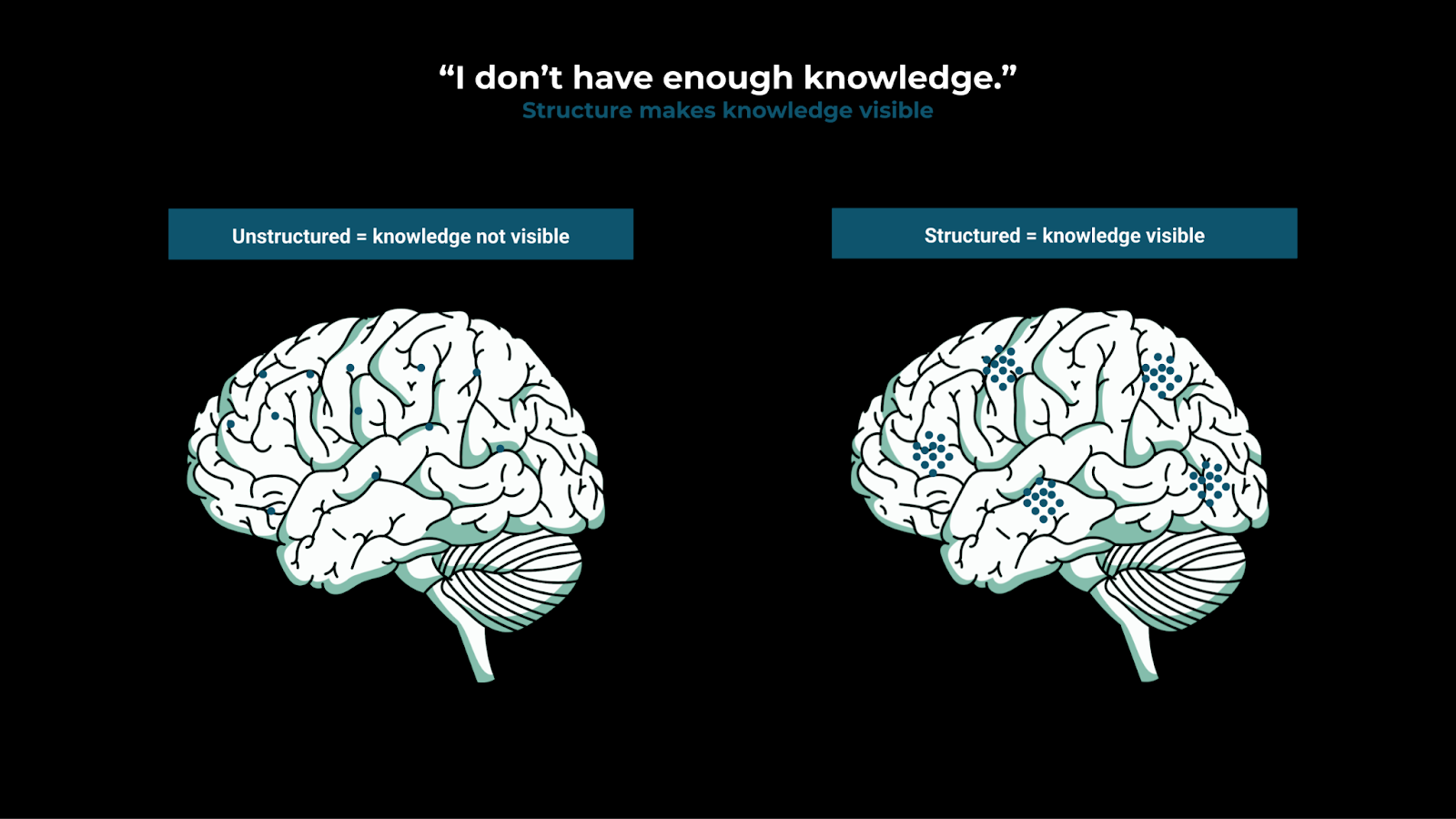
I consume sector content obsessively: articles, podcasts, newsletters, research reports … For a long time, all of the reading and listening was frankly worthless because I’d either not remember stuff or never find the right notes to refer back to. There was no structure.
The turning point was discovering personal knowledge management and building a "Second Brain": a system for capturing ideas, organising them, distilling them into new insights, and expressing them whether in reports, presentations, or social media posts.
My Second Brain has changed my professional life. It provides structure for the information I’m consuming. That structure allows me to consolidate the information into new knowledge, which I then share with my clients.
Practical takeaways
Many of us are introverts. Many often find traditional “networking” awkward or transactional. Many live far from media hubs.