Guardian Zeitgeist filters news by 'attention of users'
New visualisation of content on Guardian.co.uk analyses users behaviour on website

– 2 min read


New visualisation of content on Guardian.co.uk analyses users behaviour on website
This article was migrated from an old version of our website in 2025. As a result, it might have some low-quality images or non-functioning links - if there's any issues you'd like to see fixed, get in touch with us at info@journalism.co.uk.
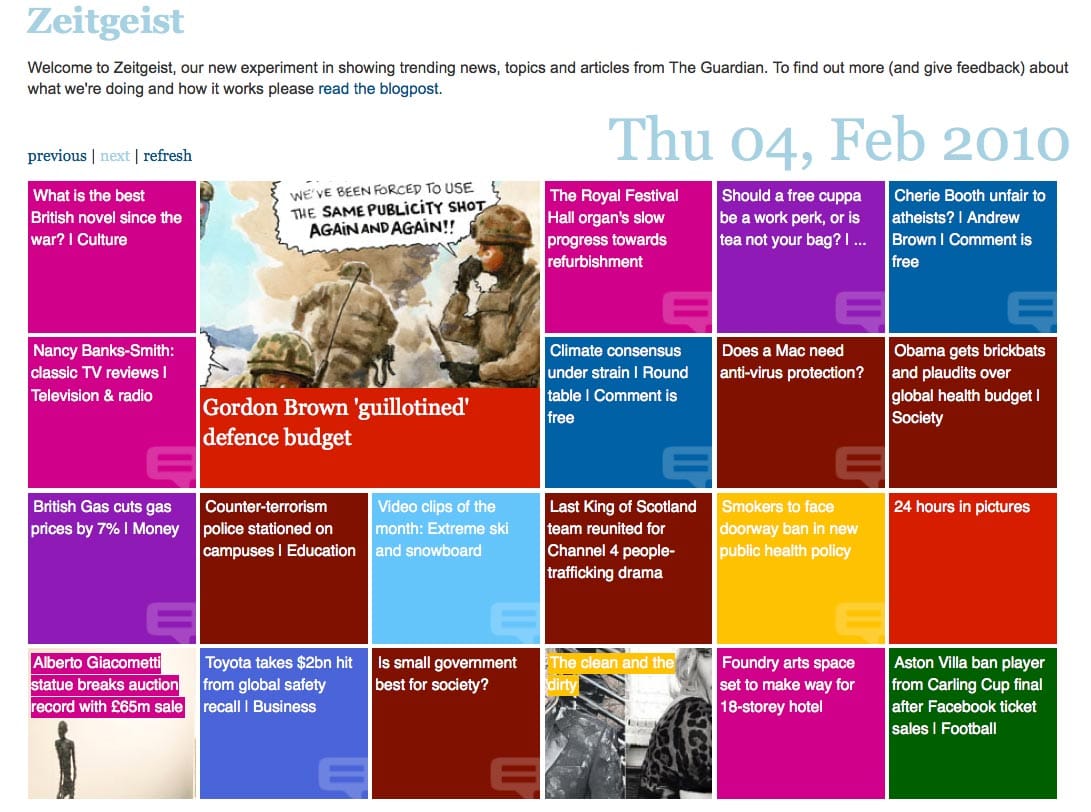
The Guardian is experimenting with a new feature on its website to show trending news, topics and articles from the website in an innovation beyond typical "most read" and "most commented on" lists.
The stories appearing on Zeitgeist and the order in which they appear on the page is driven by "the attention of users", rather than by editors, like the site's front page, or by metadata, such as showing blog posts in chronological order.
To create the visualisation the behaviour of Guardian.co.uk readers is being analysed to determine the attention different articles and content has received from readers, including: what sites they come to the Guardian form and go to after; how long they stay on a page; if they share links to a page on social sites; and the number of comments on a piece.
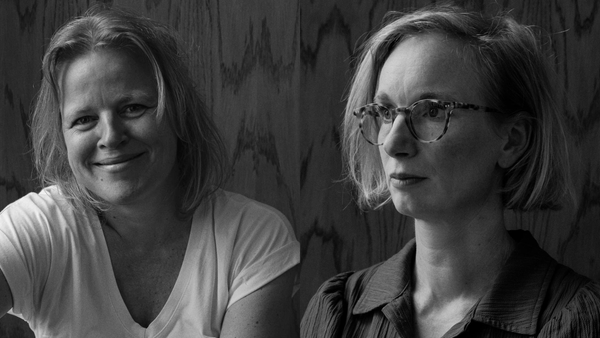
"This is an alternative way of exploring things on the Guardian site which are currently getting attention from our readers. Front pages and section fronts, curated by editors, are traditionally a great way of seeing what's important - in terms of news agenda, recency or big themes. Zeitgeist provides an alternative, emerging, community-curated view on what's currently interesting on our site," Meg Pickard and Dan Catt, who have developed Zeitgeist, told Journalism.co.uk.
"It's different from "most read" or "most commented" lists, because it draws on far more data, and analyses it in a sophisticated way to generate more meaningful results. (You should also look at http://twopointouch.com/media/taming-the-spirit-of-the-times/ , which someone just posted about the project).
"We liked the idea of building an experience which people could dip into periodically, but always find something which others have found engaging."
Stories displaying on the page are colour-coded according to the section of the Guardian they appeared in. Each piece of content analysed is only compared to other items in the same section, which makes it significantly different from "most read" and "most commented on" lists, its developers said.
The feature will also be of use to Guardian journalists and web teams: "The data produced by this can provide additional insight about what captures people's attention and how that attention and engagement evolves over time, which may lead to a deeper understanding of how people consume, transfer and engage with content in a medium which is still (relatively) young and always changing."
Work is still being done on Zeitgeist and the current version is described as "functional". New applications of the system and work to improve it are planned and more data will be collected and analysed each day, says a blog post from Catt and Pickard .