Brazilian publisher Grupo RBS is using tablets to migrate print subscribers to digital
The publisher is attempting to persuade print subscribers to start reading a digital replica of the Zero Hora paper, published on tablets, to cut distribution costs
This article was migrated from an old version of our website in 2025. As a result, it might have some low-quality images or non-functioning links - if there's any issues you'd like to see fixed, get in touch with us at info@journalism.co.uk.
In a bid to convert its print subscribers to digital, Brazilian publisher Grupo RBS has been experimenting with tablet publishing, distributing a paid-for digital edition of its most popular title, Zero Hora.
“It is the beginning of an important transition for this profile of traditionally print readers,” said Petterle.
“It's a different offer to the standard online subscription we have for the digital-savvy audience who are very experienced on mobile, as although our print subscribers are used to being online, they prefer the structured reading experience of news that a print newspaper offers."
It is the beginning of an important transition for this profile of traditionally print readers - Andiara Petterle, vice president of newspapers and digital media, Groupo RBS
The tablet comes with two apps already installed: the regular Zero Hora tablet app, with real-time news published on its website; and the new digital newspaper app, Zero Hora Journal, where users interact with the digital version of the newspaper.
Petterle noted that understanding customer behaviour is critical to long term success.
Zero Hora’s loyal print subscribers don’t like consuming articles online, preferring the curation of newspapers and valuing the worth of a physical product, which makes them feel they are well informed once they have read the whole publication.
"We are calling this an 'extractor experience with news'," said Petterle.
“The replica paper on the tablet is quite similar to the print version and gives the experience of reading the newspaper in full, but includes a lot of interactivity, such as videos, audio and even crossword puzzles."
At the beginning of the year, Canadian newspaper La Presse stopped printing its daily edition, focusing instead on La Presse+, a free tablet app it has been promoting to its print readers for years.
Petterle explained that by distributing Zero Hora digitally, Grupo RBS has been financially able to provide more for its subscribers, also offering users access to an evening edition of the digital newspaper.
The tablets have been distributed as part of the subscription since the experiment started at the beginning of this year, but come with a 12 month lock-up plan.
"Our print subscribers usually stay with us for six to seven years," said Petterle.
"Every year it costs us pretty much the price of a tablet to print and home-deliver the newspapers six days a week, so this is a more sustainable model.”
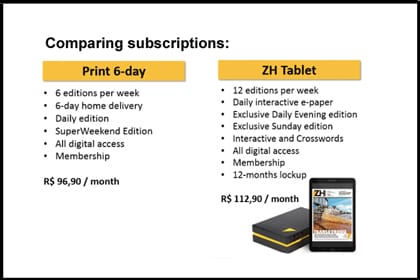
The printing and the logistics of Zero Hora make up for approximately 60 per cent of costs, with 6-day print subscribers paying R$96.90 (about £20) per month.
The publisher is trying to convince rural subscribers to migrate to the tablets, as the distribution costs are much higher outside the metropolitan area in Brazil.
Grupo RBS
By charging its print readers a slightly higher subscription fee for the digital newspaper and tablet at R$112,90 (£23) per month, RBS hopes this new print-to-digital subscription will enable it to have a sustainable business over the next decade.
“This subscription model could help a lot of local or regional newspapers who have huge logistical costs with print – especially those with home delivery,” said Petterle.
“Publishers like us, with small databases, who are not pursuing the scale of a national or global brand, definitely need something that is highly priced.”
Grupo RBS built a subscriber base of 3000 tablet users between January and March this year, and expects to build up a database of around 30000 by 2018-2019.