Climate journalism: bandwagon, zeitgeist or audience growth opportunity?
Readers value news which matters to them. Bloomberg, The Sun, Forbes, The Times and The Financial Times have all launched climate coverage products on the back of growing demand for green 'news you can use'
This article was migrated from an old version of our website in 2025. As a result, it might have some low-quality images or non-functioning links - if there's any issues you'd like to see fixed, get in touch with us at info@journalism.co.uk.
While coronavirus is still dominating the news cycle, that does not mean other important subjects have fallen by the wayside. In fact, many news organisations have focused on another important subject: climate change and environmentalism.
The new initiatives go by many names: hubs, sections, special editions, channels and campaigns. But the point is that media organisations have been steadily rolling out climate change initiatives over the last 16 months even while the world is wrestling with a pandemic.
Is this another fad, or are journalists waking up to a genuine audience interest point? The bigger question is, without trying to be hasty: when the interest in news about the coronavirus decreases, could climate become the next important topic for audience engagement?
Journalism.co.uk emailed some of the leading legacy news organisations which are stepping up their coverage on climate change to find out.
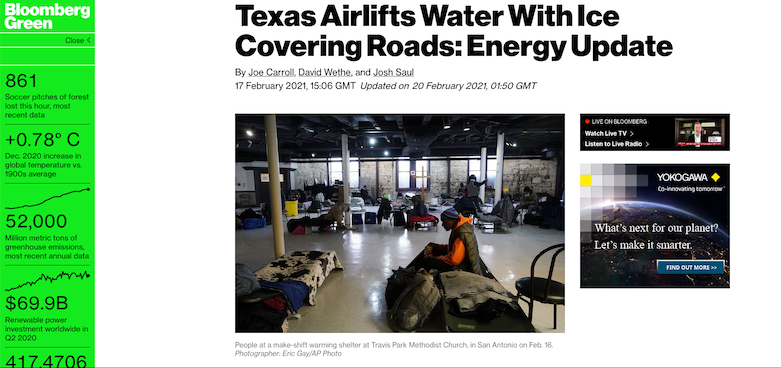
At the centre of the new product is the Climate Data Dashboard which appears alongside every story. It tracks live data points on climate developments, such as tree loss, air pollution, carbon-free energy and more. It was inspired by Bloomberg's 2015 data project What's Really Warming the World? which was one of its most viewed articles ever on the website, according to Bloomberg Green editor Aaron Rutkoff.
"We have been ahead of the curve in putting data at the forefront of our climate journalism and taking a whole newsroom approach, rather than relying only on an old-fashioned environment desk for our coverage. In that way, the work appearing in Bloomberg Green goes far beyond the team of climate reporters and editors," he says.
Climate data on a Bloomberg Green story (taken on 18 May 2021)
"It's true that climate change isn't a single beat," says Rutkoff. "In fact, it's a part of virtually every beat at Bloomberg - no matter if you cover energy or Wall Street or consumer products. By creating a new brand for climate journalism, we make these stories more visible and create a tendency in our audience to expect a different kind of climate coverage from Bloomberg than what you might find elsewhere."
He does not agree that climate journalism has become a bandwagon for media organisations to pounce on. Rather, climate's impact on the essential news agenda - business, politics, finance, technology, and human lives - makes it an accessible topic for most newsrooms.
"The clean-energy transition itself is going to mark a fundamental shift in capitalism, with trillions of dollars deployed to bring about a lower-carbon world. Journalism doesn't get any more interesting than that," explains Rutkoff.
To his surprise, stories about Exxon's emissions and clean energy managed to hold their own in a news cycle dominated by a pandemic and a US election. It is a sign that this topic will continue to gain traction, especially as the UK will be hosting COP26, the United Nations Climate Change Conference, this November in Glasgow.
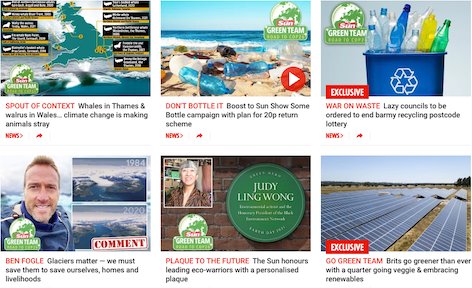
The Sun's Green Team
"Climate news isn't traditionally something people go to The Sun for," says Natasha Clark, political correspondent of The Sun, and a central figure in the newspaper's Green Team.
Internal polling and focus groups revealed that, in fact, 82 per cent of The Sun readers wanted to lead greener lives. In response, the team was launched in October 2020 as an editorial campaign to cover small lifestyle changes that can help save the planet.
Clark also cites COP26 as a big motivator; Britain being on the world stage represents a chance for readers to be part of something bigger.
"It’s clear to us that climate change has now become an issue no one can ignore, and we have a duty to tell our readers what it means for them, bring them on the green journey, and fight for a fair deal for them. Politicians and the public are finally waking up to the urgency of climate change," adds Clark.
"We're seeing the green readership growing and I’m hopeful that will continue as our campaigns pick up the pace and we get nearer to COP26. I've had a hugely positive reaction to picking up the green beat and I’m delighted so many people have been in touch about working together and telling green stories in a fun, Sun way."
"It's not just about making people feel guilty about going on holiday, we need actions that people can take which will make a tangible difference," adds Clark.
"[Green stories] are across every subject area - from the payback on installing solar panels, the best electric cars, to sustainable fashion tips and household recycling advice. The content has to be fun and engaging and relevant to people's real lives."
The UK government also has ambitious targets ahead of its pledge to achieve net-zero greenhouse gas emissions by 2050, which means there will not be a shortage of stories scrutinising these targets or how this affects readers. Put simply, these are stories that readers value because they matter to their everyday lives.
"[Climate change and the environment has] felt like a side issue for most of my lifetime. But now it’s becoming mainstream - everyone from business to government, to the people on the street care about the impact humans and our lifestyles are having on the planet. It’s simply impossible to ignore.
"Covid-19 has shown just how important the environment is for many people - when a walk in the park is the highlight of your day it reminds people how vital it is to take care of it for future generations."
Since then, reader engagement has been growing. For climate journalism stories, page views rose 34 per cent between January and February and the number of global readers increased by 37 per cent.
"That suggests an untapped demand and real reader interest which we believe will be sustained," says FT's climate editor Emiliya Mychasuk.
FT readers wanted 'news they could use' to inform purchasing decisions and behaviours, as well as conversations with friends, family, and colleagues.
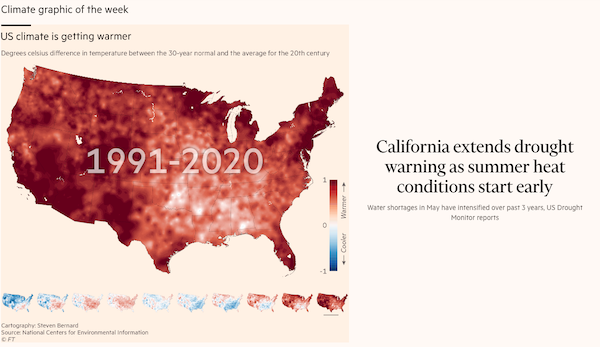
FT's climate graphic of the week depicting increasing heat in the US
"Climate change, sustainable investing and related technologies are huge themes for businesses as society, investors and governments have become focused on the need to address the real global risks that have been highlighted by the covid crisis," adds Mychasuk.
"The rise in reader interest and awareness about climate change is concurrent with the pandemic and reinforces the FT's New Agenda approach to its journalism and coverage of all aspects of environmental, social and governance issues."
The Times' Earth Channel
Last month's Earth Day was an opportunity that many news organisations took to emphasise their commitment to environmental reporting.
"I think this is a massive awakening [to an audience need]," says Spencer. "But even if it is a bandwagon, does that matter? You are drawing people into the space, highlighting it to readers, putting pressure on politicians."
"It might not stay that way. This might be a bandwagon but we're at a point when it makes sense for newspapers and broadcasters to focus on it. As journalists, all we can do is take that opportunity and get our stuff in the paper in the best way we can. I remember a time when it was very hard to get environmental reporting on the frontpages: that's not now."
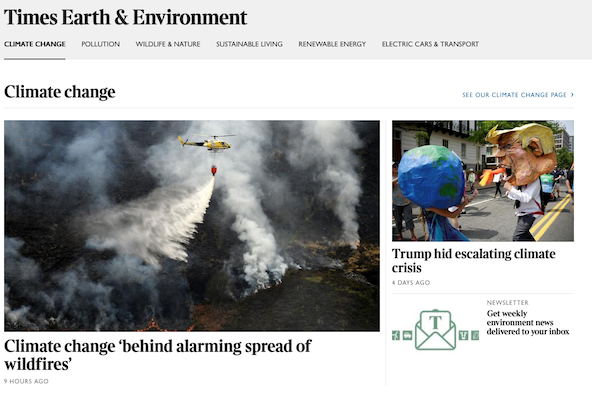
A range of topics on The Times' Earth Channel
Times' audiences are showing a strong preference for green stories with practical value. For example, Spencer's recent piece about the future of the home gas boiler, which went out on the Sunday of Prince Phillip's funeral, outperformed all royal coverage that day.
Other stories, like explainers on the UK's road to net-zero, have performed better for dwell time (the length of time readers spend interacting with the article) than clicks. It means there might not have been such a wide appeal but those who landed on the article found genuine value in the story.
The initiative brings together Forbes' worldwide experts and contributors. Its focus is on where sustainability concerns other sectors like retail, travel, transportation, investment, food and drink, and science.
"The goal is to create a coverage space that reflects all areas of sustainability and a variety of expertise from different industries, which is why we've recruited writers from across existing Forbes verticals," says Sofia Lotto Persio, assistant editor of Forbes and editorial lead of sustainability.
"I'm also working with colleagues from different editorial teams on reporting projects that will have a sustainability angle. I think it's important for sustainability coverage to have its own home while also being deeply intertwined with the rest of the newsroom, to avoid it being siloed."
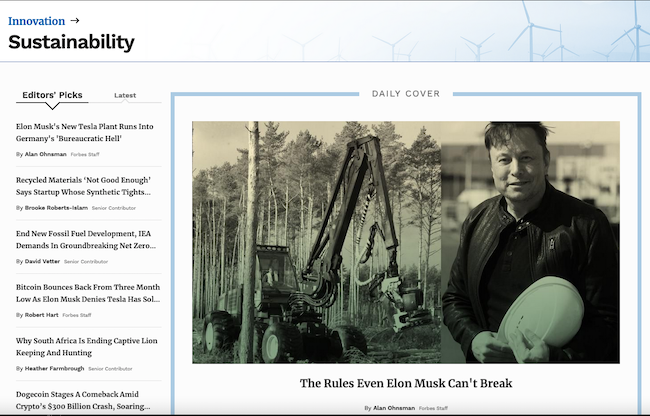
Editor's picks on Forbes' Sustainability channel
Prior to creating this channel, Forbes had a newsletter focused on positive news. It asked readers for feedback on stories they would be interested in reading. What emerged was "overwhelming demand" for stories that tracked and explained progress in the fight against climate change.
According to wider commissioned research, Forbes readers are more than twice as likely than the average internet user to visit websites in the global warming or green living categories. At the same time, potential contributors felt Forbes was lacking a dedicated space within its existing editorial channels to take full advantage of this
"It felt like there was both supply and demand for more sustainability content," explains Lotto Persio.
"Reducing carbon emissions or being carbon negative isn't just something done for the good of the planet. It's a business imperative for anyone who cares for their business to still be thriving in the years and decades to come."
She welcomes increased media attention around the environment, describing it as a "zeitgeist more than a bandwagon" and "a reflection of increased interest in writing and reading about this topic".
We are continuing the discussion on the future of climate journalism at our digital journalism conference Newsrewired on 27 May 2020.Book your place today