This article was migrated from an old version of our website in 2025. As a result, it might have some low-quality images or non-functioning links - if there's any issues you'd like to see fixed, get in touch with us at info@journalism.co.uk.
Culture secretary Jeremy Hunt has said accusations that he backed
News Corporation's bid for BSkyB are "laughable" and
"categorically" denied allegations of a "back channel" giving News
Corporation the ability to influence decisions.
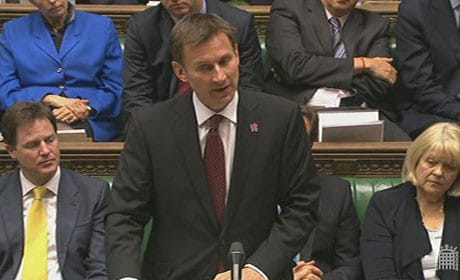
Hunt delivered a statement to the House of Commons today in
response to evidence heard during former News International
chairman James Murdoch's appearance before the Leveson inquiry yesterday (24
April).
Murdoch told the inquiry that News Corporation was "receiving feedback and information" via
its public affairs channel relating to News Corporation's bid for
BSkyB from the culture secretary's office, but denied the
interactions were "covert".
The communications include a series of emails sent from News
Corporation's head of public affairs Fréderic Michel and refer to
contact with Hunt's office, with those after the date of 24
December 2010 relating to information he was "told by someone
within Jeremy Hunt’s office, almost invariably his special advisor
Adam Smith", as opposed to directly by Hunt.
Counsel for the inquiry Robert Jay QC yesterday questioned James
Murdoch on whether some of the emails submitted to the inquiry
suggest News Corporation was "getting insight into Hunt's current
thinking" and the "current state of affairs".
Murdoch said there was "nothing inappropriate" about the
interactions between News Corporation's public affairs channel and
Hunt's office, adding that comments received were taken "with a
grain of salt".
Smith, Hunt's special advisor, today announced his resignation , saying that while it was part
of his role "to keep News Corporation informed throughout the BSkyB
bid process, the content and extent of my contact was done without
authorisation from the secretary of state".
Deputy Labour leader Harriet Harman has called for Hunt to resign,
saying: "In view of the evidence that has been adduced before the
Leveson inquiry today, it appears that the secretary of state has
fallen woefully short of the standards expected from him in his
office and in the public interest.
"I believe that the right thing for the secretary of state to do
would be to come to the house to offer an apology and tender his
resignation."
In a statement issued last night, Hunt said: "Now is not a time for
knee-jerk reactions. We've heard one side of the story today but
some of the evidence reported meetings and conversations that
simply didn't happen.
"Rather than jump on political bandwagon, we need to hear what Lord
Justice Leveson thinks after he's heard all the evidence."
Hunt has also asked Lord Justice Leveson if his appearance before
the inquiry could be brought forward.
Hunt today said he first saw the Michel communications yesterday
and said he was not aware of the tone or volume of the
communications.
In his statement to the House today Hunt insisted that in relation
to the BSkyB bid he "strictly followed due process" and sought the
advice of independent regulators.
He said the communications did not influence his decisions in any
way, but added it is a "matter of huge regret to me that this has
happened".
He outlined to the House four decisions he took in the process
which he claimed were all "against what News Corporation
wanted".
"The idea I was backing the bid is laughable".
In prime minister's questions, prior to Hunt's statement, prime
minister David Cameron offered his "full support" for the culture
secretary.
Cameron defended Hunt, saying he "sought independent advice at
every stage of the bid" and "took advice at every stage".
Leader of the opposition Ed Miliband repeated calls for Hunt to
step down, telling Cameron: "If he can't defend his ministers he
must fire them."