RISJ Digital News Report: New models emerging from the wreckage of digital disruption
The 2017 Digital News Report offers some glimmers of hope that the news industry in Europe is beginning to move forward with new approaches and fresh thinking

This article was migrated from an old version of our website in 2025. As a result, it might have some low-quality images or non-functioning links - if there's any issues you'd like to see fixed, get in touch with us at info@journalism.co.uk.
This year’s Digital News Report from the Reuters Institute for the Study of Journalism, published today (22 June), is full of the usual concerns about fake news, failing business models, and the growing power of platforms.
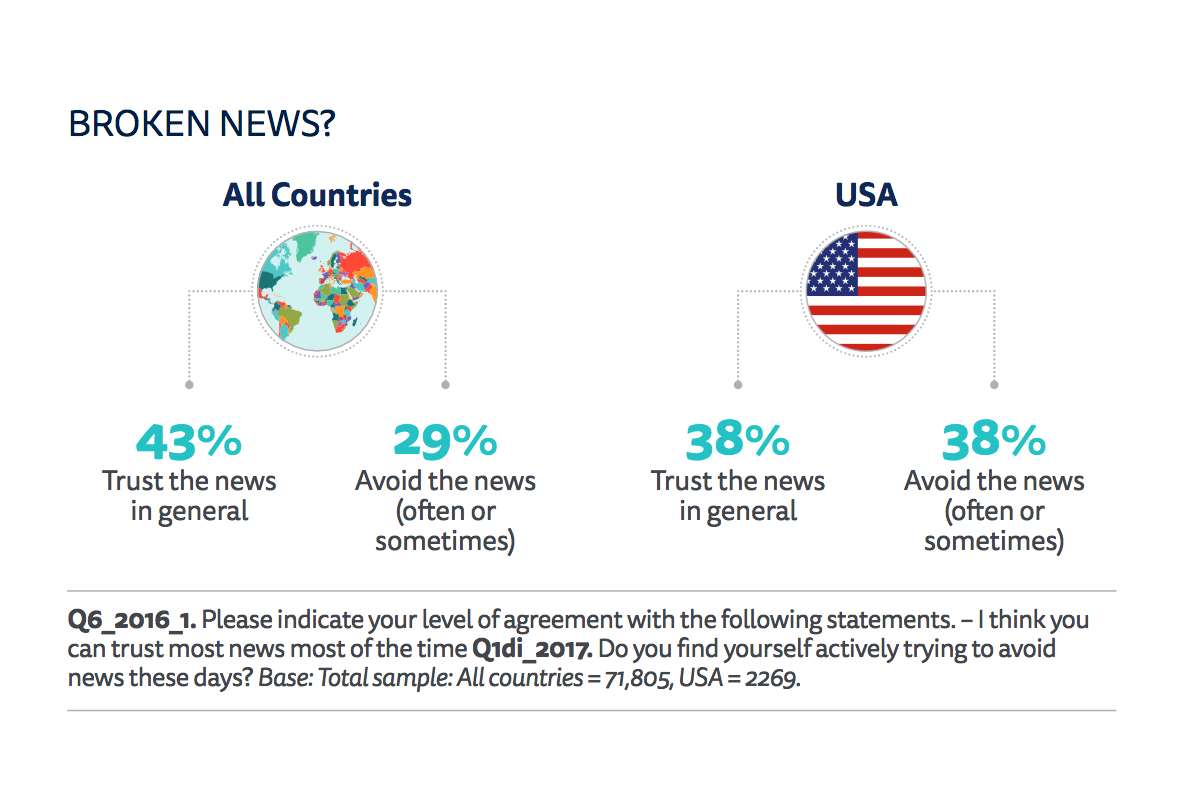
In many ways, the headline figures around news have got even worse in the last 12 months, with low trust and high levels of news avoidance, combined with staff cutbacks in commercial and public service media, that suggest we may be locked into a destructive and downward spiral of confidence in the news.

Across all the countries we looked at in our report, over half (54 per cent) now get their news from social media, though just 20 per cent think that platforms like Facebook do a good job in separating fact from fiction. In our focus groups this year, many respondents felt that it was getting harder to find the signal from the noise.
And yet, there are signs that we may have reached the bottom. Lying behind these bleak quotes and statistics is a growing recognition from publishers, platforms and consumers that something ‘must be done’ to restore trust, confidence and fortune.
Many news organisations have been refocusing their business on high quality unique journalism that people would be prepared to pay for, as well as ways to demonstrate the transparency, fairness, and accountability of their journalism (fact-checking etc).
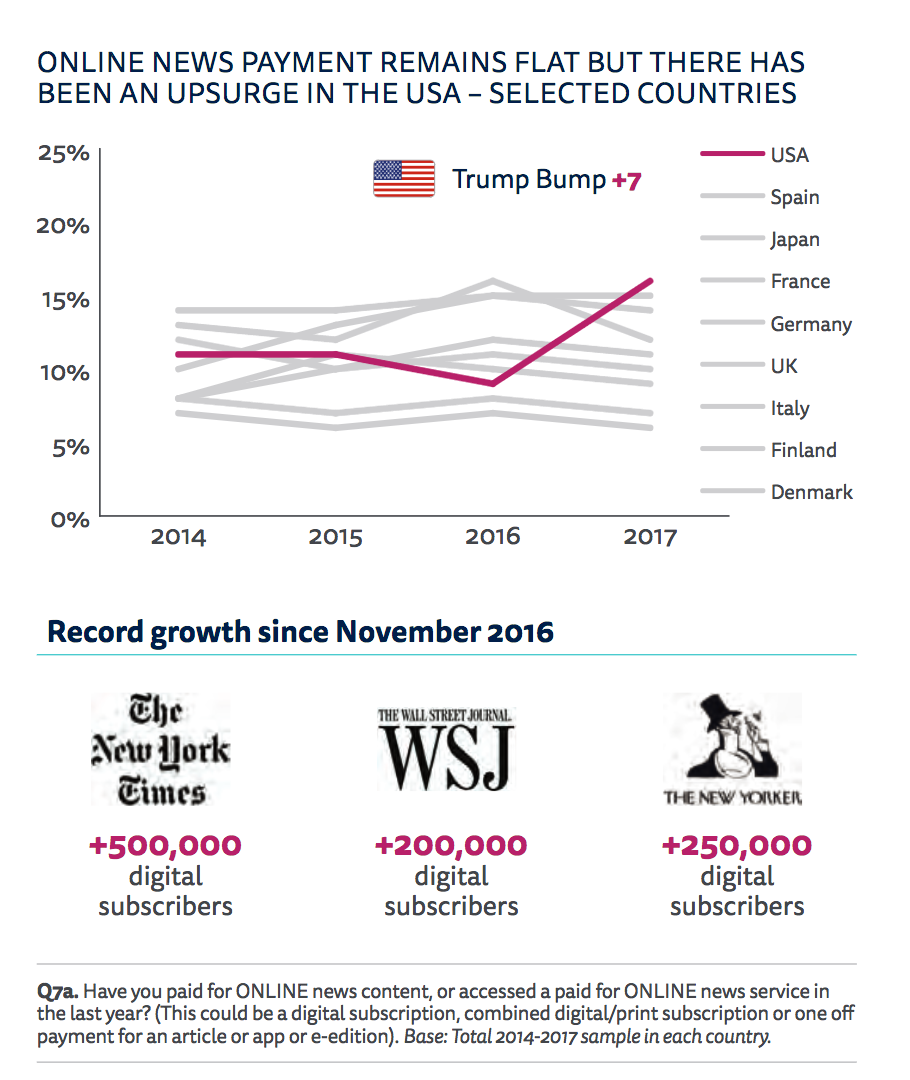
The New York Times, The Wall Street Journal and The Washington Post have been leading this charge in the United States, where we have seen a significant uptick in consumers prepared to pay for online news (up 7 percentage points from last year). The level of donations to news organisations has also tripled, albeit from a low base. Almost a third of those paying (29 per cent) say they have done it to help support journalism, more than double the all-country average.
Even more surprisingly, much of the growth has come from under 35s, a group that has already shown itself prepared to dig into its pocket for other online media through services like Netflix and Spotify.

It is worth noting that Donald Trump’s presidency has brought a unique set of circumstances which are currently only benefitting a small part of the publishing industry. Not all publishers are yet in a position where they can charge directly for content.
Across all countries, only around one in ten (13 per cent) pay for online news but some regions (Nordics) are doing much better than others. Around a quarter pay for online news in Norway (26 per cent) and around a fifth in Sweden (20 per cent) compared with just 6 per cent in the UK and Greece. In Asia, Latin America, and Southern Europe dependence on digital advertising continues, while the willingness or ability of readers to pay directly is more limited.
In the UK, and other English language countries, the problem is more about the abundance of free news and the consequent difficulty in charging. Our UK focus groups suggested more could be persuaded to pay in the future but only for high quality distinctive news or if the majority of publishers started charging.
It was also clear from our international focus groups that consumers are not prepared to give up the benefit of using multiple brands online. That’s why the individual subscription approach being pursued by most publishers is unlikely to succeed in the long-term for all but the most highly prized news titles. In that respect, it has been fascinating to see alternative approaches that try to square that circle emerging across Europe:
Beyond payment, we are also seeing a number of initiatives around sharing of content or other forms of cooperation between news organisations that would have been unheard of a few years ago. In Belgium and Switzerland, public broadcaster video content is used for free by commercial media on their own websites. Austria has started a video content sharing network between commercial and public service media with profit sharing built in.
Swiss Tages-Anzeiger, Tamedia’s flagship newspaper, now shares its foreign correspondent network with the German Süddeutsche Zeitung. In Spain, El Diario has been able to expand into sport and world news though a partnership agreement with the Guardian. Publishers have also been cooperating over initiatives to combat fake news in Norway (NRK and Dagbladet’s owner, the Tinius Trust), in Korea, and in France through the CrossCheck initiative.
We also find a host of advertising and technical approaches to try to create greater scale. In Norway and Sweden, Schibsted has consolidated its technology into a single platform which it hopes will ultimately be used by other publishers. In Switzerland, SRG, SwissCom and Ringier have combined to launch a common advertising platform, and there are similar initiatives underway elsewhere.
Across Europe we are witnessing a new climate of media collaboration and innovation. Faced with unprecedented levels of digital disruption, it is increasingly clear that the old models can no longer sustain the quality and range of journalism that we’ve been used to in the past.
To do nothing will be to play into the hands of the platforms that will be able to leverage their superior technology and greater scale – or into the hands of hyper-partisan extremists that operate on low cost bases and can distribute content for free.
The crisis of trust in news, ironically, could be the best thing that has happened to journalism in a long time if it sparks more of the innovation, fresh thinking and audience focus that is starting to unfold.
***Nic Newman is currently a research associate at the Reuters Institute for the Study of Journalism** and lead author of the Digital News Report. He is also a consultant on digital media, working actively with news companies on product, audience, and business strategies for digital transition.*