Source Code stage notes: What journalists really want to know about the future of AI and news
Seven journalists talk about how AI is reshaping trust, money, and the newsroom - here are key takeaways from the Source Code event that brought journalists and technologists together
Tal Gottesman, PA Media, taking a question from the audience at Source Code (30 June 2026)
Last week (30 June), journalists and technologists gathered to discuss the intersection of tech and journalism at the second event of Source Code, our spiritual successor to the Hacks Hackers events of old.
We heard from seven speakers from organisations like the Reuters Institute, the BBC, PA Media, the i Paper, and independent publishers, who addressed how AI is reshaping how news is made, distributed, trusted and monetised.
Really, the standout part of the event was an engaged audience that asked plenty of tough and smart questions. We picked the best ones, and if you want to come and ask a question (or be a speaker at the next event), do get in touch.
1. Digital News Report 2026:
Jim Egan, Reuters Institute for the Study of Journalism
Context: The Reuters Institute Digital News Report is second to none as a study of global news consumption, but this year it featured a new lead author, Jim Egan, whose career spans top roles at FT Strategies, MDIF, BBC News and Ofcom. He presented a few of his most surprising findings, namely that news creators and influencers are supplementing, but not replacing, traditional news brands. News avoidance and distrust are also rising, especially in the UK.
Key fact: In the UK, three quarters (77 per cent) of people worry about fake news and disinformation, and it is the lowest market in the study for trust in news on AI chatbots.
Audience Q&A: Q: Your data suggests there’s a reduction in loyalty to specific news outlets, and an increase in trust to a wider variety of sources on the third party platforms. There’s a deep sense of loyalty in a small group of loyal subscribers. Is this healthy?”
A: It depends on the audience. People who mainly get news on social media tend to have the lowest interest in news and come across it incidentally. For publishers focused on subscriptions, these aren't the people you’re likely to convert anyway -it’s hard to monetise or build loyalty on third-party platforms. For policymakers, though, there's a bigger concern about the democratic impact of people drifting away from news. So, the significance of this shift really varies depending on your perspective.
2. CMA vs Google: How publishers should fight back
Referral-traffic-linked rates for publishers have dropped by about 40 per cent since the shift to AI-driven content scraping. "Search-only terms and conditions" can shift copyright law to contract law for content protection, resulting in a £500 fee per unauthorised scrape/use, arbitrated via small court claims.
Audit your scraping exposure (with tools like TollBit and Sentinel)
Engage directly with the CMA and share data with them
Coordinate with other publishers or alliances (e.g. Independent Publishers Alliance) for collective leverage.
Audience Q&A: Q: "Even with new legal tools, how can publishers actually enforce their rights against third-party scrapers?"
A: "You go after the scrapers directly: send them the bill, as contract law now allows. And you notify the big companies they work with, making it a reputational and legal risk. It's early days, but the more publishers document and coordinate, the stronger the collective pushback."
3. The AI measurement gap: How can you track what your journalism delivers?
Steve Jones, Maro (Sponsored session)
Context: As news is increasingly distributed and surfaced by AI platforms, publishers struggle to see where and how their content is being used, cited, or engaged with, especially beyond their own websites. Maro, a platform for tracking story performance across multiple channels, is working with major publishers and the Spur coalition to develop "Content Telemetry Standards." These standards aim to provide a new, industry-wide way to measure content impact in the AI era, much like the "page view" once did for web analytics.
Key insight: The tool wants to make it easy for editors to understand how their stories are doing on AI platforms and provide clear, at-a-glance data instead of confusing numbers. That way, they can quickly spot what's working and tweak their approach. As content spreads across more and more platforms, having this kind of clear visibility is key to making smart editorial and business calls.
Help us shape JUK. Take our quick audience survey for a chance to win one of six brilliant books. It only takes five minutes - your voice will directly influence our future coverage and make a real impact
4. 2 humans, 50 agents: Welcome to the AI newsroom
Peter Stuart, Velora Digital
Context: Velora Digital, an AI editorial content platform, runs a two-human newsroom powered by dozens of AI agents, automating everything from news discovery to social asset creation.
Velora has built an AI-powered publishing workflow: news discovery, research, drafting, human review, publishing, distribution. Stuart says that it is intended to make AI do repetitive or monotonous tasks while humans retain accountability and judgement.
Key case study: A breaking news story went from press release to published article in just 19 minutes, requiring one full-time staffer as AI handles the repetitive but necessary tasks (verification and social media asset creation).
Audience Q&A: Q: "Aren’t you just automating the same kind of content scraping and aggregation that publishers are fighting against? How is this different from what Google or AI scrapers do?"
A: "That’s a totally valid question. How you use other people's content is an editorial decision. Aggregation isn't much different from trading, but we don’t support aggregation as our sole output. Most of what we publish isn’t leaning entirely on the work of other journalists. We use content from social media, teams, podcasts, or interviews, but we aim for differentiation and originality. The mechanism could be used for pure aggregation, but that’s not what we advocate or do."
5. The report that writes itself: Turning data into editorial action
Maya Ninel, The i Paper
Context: To address the daily flood of repetitive data questions from editors, Thei Paper’s head of insights and impact, Maya Ninel, built an automated editorial report using Microsoft's Power Automate. The system pulls key metrics, classifies articles by reader mode, and generates AI-written analysis and performance breakdowns. Calculations, rules, and thresholds are encoded "upstream" in code, while the AI handles context, framing, and language, delivering a daily, digestible report directly to editors' inboxes.
Key insight: Automating routine reporting has significantly reduced repetitive questions from editors. Now, instead of fielding the same basic queries, Maya receives more tailored and strategic questions. The automation ensures everyone starts the day with the same context, freeing up time for deeper editorial conversations and more nuanced decision-making.
Audience Q&A: Q: "Have you compared the quality of agent work versus human work, and in what dimension do you measure the quality of your product?"
A: "The standard was me. I tested the report on myself for three months, making changes until it met my expectations. Now, the quality is good enough to send automatically to my editor-in-chief without saying anything crazy. It's tightly constrained in how it describes things, so while I sometimes prefer a different language, it’s reliable. If I rolled it out more widely, I'd add machine learning and tracking to measure quality more systematically."
6. Beyond the pilot: what does real AI adoption look like inside the BBC?
Nathalie Malinarich, BBC News
Context: The BBC has moved beyond isolated AI pilots by introducing structured governance and innovative staff engagement, including Dragon’s Den-style pitch competitions to surface and prioritise the best ideas for newsroom AI adoption.
Key idea: Dragon’s Den sessions gave staff a week to pitch AI ideas, with shortlisted projects presented to a panel of product and editorial leaders. This approach tapped into journalists’ natural competitiveness, generated excitement, and led to immediate increases in AI usage across the newsroom. By making innovation participatory and competitive, the BBC fostered a culture where staff felt invested in AI projects and governance was directly linked to top editorial priorities.
Audience Q&A: Q: "When you have a mix of enthusiastic and indifferent staff, how do you get everyone engaged in these programs?"
A: "At first, people were puzzled, but laying the groundwork helped: explaining why we're doing this and what responsibility means. Setting up a cohort for sharing experiences made a big difference. Even sceptics became more open when they saw colleagues using AI in ways that worked for them."
7. Start, stop, continue: PA on the future of trusted journalism
Tal Gottesman, PA Media
Context: As news travels further from its source, trust can't just live in a brand name. PA Media argues that trust must be embedded in sourcing, captions, corrections, and context wherever journalism appears.
Key insight: The foundational disciplines of accuracy, verification, and human accountability are more important than ever, even as workflows and platforms evolve.
Audience Q&A: Q: "With so much distrust and AI-generated content, how do you rebuild trust in journalism?"
A: "It always comes back to verifiable, sourced, legally sound reporting. We can't control how others use our work, but we can ensure what we produce is trustworthy and transparent, so audiences and clients know where it comes from."
This article was generated with the help of an AI assistant with lots of human prompting and editing. The Q&A exchanges in this piece have been edited and condensed for clarity and brevity
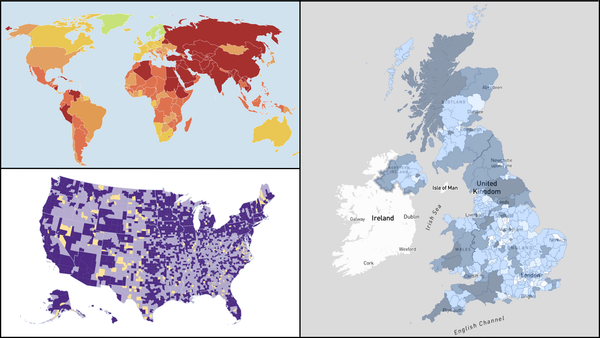
Screenshots of Reporters Without Borders Press Freedom Index (top left), Northwestern Local News Landscape (bottom left) and Public Interest News Foundation Local News Map (right)